Categories
Latest news

CIVIL PROTECTION: BALANCE OF THE WEEK, FROM 8 TO 14 JULY, 9098 OCCURRENCES WERE RECORDED

Civil Protection revealed that, from 8 to 14 July, 9098 occurrences were recorded.

According to national commander André Fernandes, more than 33000 operatives participated in these events, supported by 8000 vehicles.

Number of occurrences is the highest in the last five years.

“Managing the available resources in such a context is a huge challenge” because, due to the current weather conditions, any ignition generates a violent fire.

José Luís Carneiro (Minister of Internal Administration) revealed at a press conference that fires are being extinguished in less than 90 minutes. Therefore, the resources “are having a degree of effectiveness in the order of 90%”.

This means that the “Portuguese firefighters” and the Civil Protection resources have “shown great effectiveness in the fight to these occurrences”.

The Secretary of State for Internal Administration Patrícia Gaspar explained about the EU Civil Protection Mechanism response that “almost all countries in southern Europe are facing the same problem with fires”. That’s why the Spanish planes came and went on the same day and that for now only Italy was able to send support.

She also said that until Sunday Portugal will face “equally complex days”, so the secretary of state asked the population to comply with “all the rules” and for each of us to be “an agent of Civil Protection”.

Categories
Latest news


SINTRA: PALACES, CASTLE AND CONVENT CLOSED TILL 17 JULY DUE TO FIRE RISK.

Adding to the already existing closures on the south entrances to the forest/sites now it’s almost the entire perimeter of Serra de Sintra that it’s closed. Including the touristy sites.

Palace and Park of Pena, Moors Castle, Convent of the Capuchos and Park and Palace of Monserrate closed till the 17th by legal imposition, due to extreme risk of rural fire.

This closure is due to the situation of contingency decreed for the entire mainland between which determines the prohibition of access, circulation and permanence within the forest areas, previously defined in the municipal forest protection plans against fires, as well as in forest paths, rural paths and other roads that cross them.

Tickets previously purchased for Pena Park, Moors Castle, Convent of the Capuchos and Park and Palace of Monserrate can be used on any other dates.

Tickets for visits to Pena Palace on these dates can be refunded by contacting Parques de Sintra or using the form found on this link https://www.parquesdesintra.pt/…/encerramento…/…

The National Palaces of Sintra and Queluz remain open during this period, with no changes to their normal operation.

Categories
Latest news


RURAL FIRE RISK 12TH JULY 2022

EXTREME RISK OF RURAL FIRES – PLEASE STUDY

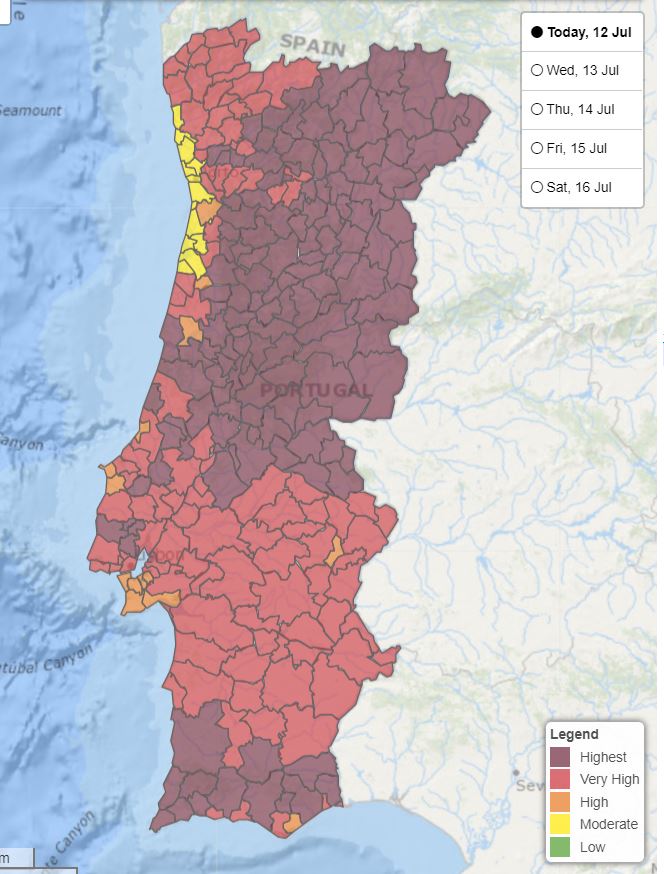
RISK TODAY (map above)

The rural fire risk is at EXTREME/VERY HIGH today throughout the mainland. The risk is being influenced by forecasts of exceptionally low Relative Humidity (RH) levels, very high temperatures and moderate winds. The Algarve, Centre an north east are all at MAXIMUM fire risk. Unusually the northwest and Alentejo are at VERY HIGH risk.

The forecast minimum relative humidity (RH) Centre is very low 5% to 9%; the north at 9% to 15% and Algarve 12% to 30%. The maximum air temperature forecast for these the areas are Centre 39C to 43C; north 38C to 43C and Algarve 31C to 39C. Winds mainly moderate. Take EXTRA CARE adopting ALL precautions to avoid inadvertently starting a fire. The risk is forecast to remain similar over next three days. https://www.ipma.pt/en/riscoincendio/rcm.pt/

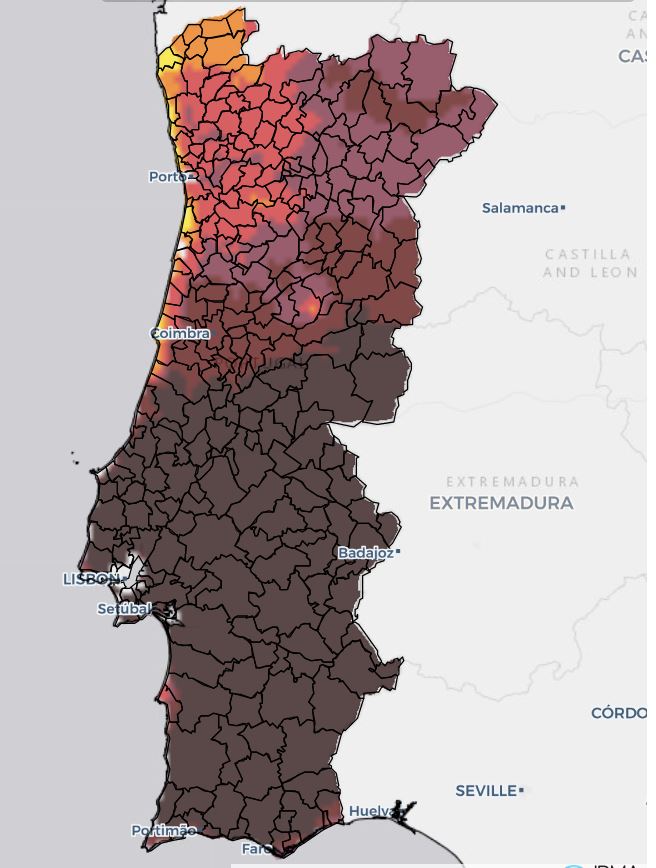
RURAL FIRE HAZARD (FWI) (Map above)

Around two thirds of the mainland including the south and centre is at MAXIMUM, the extent of which has not been seen for some years. The north east is very high and the northwest high to moderate. The major fires of 2003, 2017 and 2018 have all been when the FWI was similar.

The rural fire hazard index comprises six indices that quantify the effects of fuel moisture and wind on fire behaviour, including its intensity and spread – these conditions ultimately affect the difficulty in fighting a fire, one a fire gets hold. The wind today has increases particularly in Algarve and highlands.

SITUATION OF CONTINGENCY MEASURES

Within the scope of the Declaration of the Contingency, provided for in the Law of Civil Protection Bases, the following exceptional measures are in place:

1) Prohibition of access, movement and permanence inside the forest spaces previously defined in the Municipal Forest Defence against Fire Plan, as well as on its forest paths, rural accesses and other accesses that cross them; (exceptions for residents and workers)

2) Prohibition of extensive burning and burning cut and piled waste;

3) Prohibition of work in forest areas with use of any kind of machinery, with the exception of those associated with rural fire fighting situations;

4) Prohibition of works in rural areas using blade or metal disks chains, lawn mowers, shredder and machines with blades or front shovels.

5) Total prohibition on the use of fireworks or other pyrotechnic items regardless of their form of combustion, as well as suspension of the permits issued;

Disobedience of these measures is a crime.. Situation of

Contingency here in English with link to Portuguese.

https://www.safecommunitiesportugal.com/current-anpc…/

If in any doubt over these provisions or assistance required, then contact 211 389 320 or 808 200 520 or local Camara Municipal.

Other ICNF normal restrictions: https://www.ipma.pt/en/riscoincendio/rcm.pt/

It will be a very challenging day so as always. IF YOU SEE A FIRE CALL 112 IMMEDIATELY – DO NOT HESITATE EVERY SECOND COUNTS. PLEASE SHARE AND TAKE CARE!
Categories
Latest news


HIGHEST NUMBER OF FIRES SO FAR THIS YEAR ANEPC SITUATION REPORT 1200 HRS 9TH JULY 2022

Carnaxide, Oeiras, Jul 9, 2022 (Lusa) – Portugal reached the maximum number of fires this year this Friday, with 121 ignitions, announced today the National Emergency and Civil Protection Authority (ANEPC), appealing to the population to take special care be careful in the face of the expected aggravation of heat.

In the ‘briefing’ to the media, held at 12:00 at the organisation’s headquarters, in Carnaxide (Oeiras), Commander André Fernandes highlighted that there are three fires of greatest concern in fighting the flames, namely in Ourém (Santarém district), Carrazeda of Ansiães (District of Bragança) and Vale da Pia (District of Leiria).

“There is a worsening of the situation, namely in the southern region. We are experiencing an almost unprecedented situation from a meteorological point of view. The situation will continue and it is forbidden to use machinery in these days that follow to lower the number of ignitions, which have been increasing”, said the ANEPC official, noting that the 121 registered ignitions “are the maximum this year”.

  • 121 Rural fires registered yesterday, 08JUL2022
  • 3 significant active occurrences: Ourem, Carrazeda de Anisaes and Pombal
  • The highest number of incidents have been registered in the Porto districts (36); Aveiro (15) and Lisbon (14)
  • 10 operatives suffered minor injuries
  • A destroyed house (Ourém)
  • Ourém with only 20% of the perimeter now active

Fire danger remains at very high levels and max. Aggravated in the South


Categories
Latest news
RURAL FIRE, AVEIRO, SEVER DO VOUGA. TALHADAS- FRAGUA

Registered with ANEPC:

Status: Active

Forest Settlement

Ref: 2022090024139

UPDATE: 12.15 hrs

The fire has just been brought to a Resolution stage according to ANEPC. “Fire with no danger of spreading beyond the perimeter” already reached”

A total of 326 operatives supported by 102 vehicles and three helicopters/fixed wing aircraft remain deployed.

UPDATE – 10h15 8th July 2022

Although still active, the National Civil Protection Authority has confirmed that the forest fire is under control. A total of 335 operatives supported by 104 vehicles and four aircraft/helicopters are deployed.

UPDATE 0930 hrs 8th July 2022

The fire remains active overnight. As at 0920 rs a total of 386 operatives supported by 120 vehicles and 3 aircraft/helicopters are deployed.

UPDATE 2300 hrs

The fire remains ACTIVE

A total of 370 operatives supported by 114 vehicles are deployed.

Although the wind has slowed down in the last few hours, strong gusts are expected during the night , which makes combat difficult and can lead to re-ignitions. The fire has already spread to the neighboring municipality of Águeda , where it is evolving with some intensity.

Aircraft have been withdrawn overnight.

SITREP 1750 HRS

The fire that broke out at 12:18 in a forested area in Sever do Vouga, in the district of Aveiro, is still active, with more than 300 people fighting the flames, a source from Civil Protection told Lusa.

“The fire remains active, with one of the fronts still causing some concern due to the difficulty of access”, said the commander of the District Operations and Relief Command (CDOS) of Aveiro, José Pinto, at 17:30.

In addition to the lack of access, firefighters are also experiencing difficulties with the strong wind that is felt in the area and which, according to José Pinto, could cause reactivations “in areas where the flames were already under control”.

“Our objective is that overnight the fire is resolved”, said the same official, adding that, for now, there are no houses in danger.

SITREP 1700 hrs

As at 1655 hrs the number of operatives had been considerably increased to 368, supported by 107 vehicles and six aircraft/helicopters

SITREP 1600 HRS

The fire is being fought by 253 operatives, supported by 73vehicles and seven fixed wing aircraft/helicopters
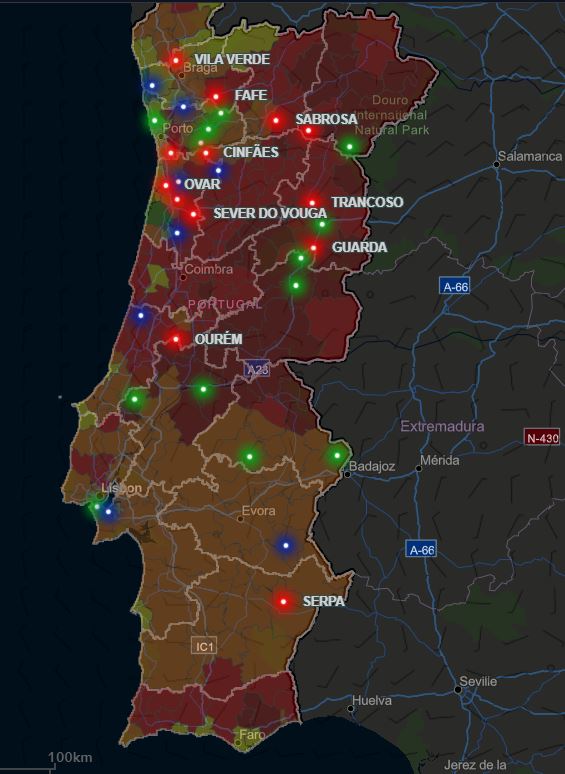
According to the Severan firefighters, the fire breaks out in a forest stand in a “critical zone”, but without endangering homes.

Speaking to Lusa, the commander of the District Center for Relief Operations (CDOS) of Aveiro, José Pinto, said that the fire has been raging around some villages, but the firefighters have managed to protect the populations.

The flames spread with intensity due to the wind that was felt, moving towards the municipality of Águeda, namely Ventoso, in the Union of Parishes of Préstimo and Macieira de Alcôba,

Temperatures in the afternoon above 30ºC and forecast at night above 20ºC

▶️Some wind in the afternoon (5km/h), but with a tendency to increase during the night (25km/h)

▶️Humidity will not go above 38%

It is, therefore, the first big fire of the summer in the region of Aveiro.

OVERAL SITUATION

As at 1630 hrs there are a total of 1154 operatives fighting 31 fires (9 active, 5 in resolution and 17 in conclusion) supported by 328 vehicles and 17 aircraft/helicopters). in terms of air means this is around 28% of availability.

Categories
Latest news


Nearly 2000 operatives fighting around 40 rural fires


Posted Facebook Thursday 7th July 1800 hrs

Yesterday (7th July 2022) mainland Portugal experienced one of the largest simultaneous deployment of operatives and other resources so far this year, coinciding with an increase in air temperature and lower humidity as well as being hampered by strong winds in some areas.

As at 1747 hrs there were 34 fires, 13 of which were at active, eight were in resolution and 13 in conclusion. A little earlier there were 38 fires.

At 1747 hrs a total of 1691 operatives were deployed, supported by 480 vehicles and 28 fixed wing aircraft/helicopters. In terms of air deployment this was nearly half of that available under the DCIR. As an update at 1925 hrs 1877 operatives were deployed support by 540 vehicles and 23 aircraft.

It was interesting to note monitoring the fires throughout the day, that 16 of these fires were registered between 1600 and 1700 hrs, as temperatures increased and the RH, and with fire operations being hampered with strong winds such as at Frágua, where over 360 operatives are deployed.

Nearly all the fires were in the centre and north of the country.

No doubt we will hear more about this in the briefing at ANEPC later this evening.

OUR CONGRATULATIONS

Our many congratulations to the emergency teams who are playing a massive role, including the aircraft pilots and crew, Bombeiros, civil protection special forces, GNR, ICNF and INEM and all other entities deployed.

There is little doubt that the pre-positioning of resources and the timely deployment of fire-fighting aircraft is having an impact on some these fires where access is very difficult for ground forces.

Categories
Latest news


Country is experiencing the worst drought ever at the start of summer


Feature ionline.sapo.pt

Alarms are sounding: water this summer will have to be managed with caution and limitations on public use are inevitable. Measures will be closed this month. May was very dry and forecasts for June are no better.

Saving water will have to be the watchword this summer. After some relief in March and April, the month of May was the hottest on record in Portugal and very dry. Accordingly the forecasts from the Portuguese Institute for the Sea and the Atmosphere, which are being worked on with the Portuguese Environment Agency, predict an even drier second half of June, which places the country in the most serious scenario ever in terms of water shortage at the beginning of summer.

The inter-ministerial meeting to assess the drought situation at the national level will take place soon, and the first package of measures for the summer should be closed at the time, after the various initiatives and constraints that took place at the beginning of the year, including the interruption of electricity production in dams where the quotas have dropped to the most critical levels (which remain).

The priority will be to ensure the water supply to the population and manage the reserves for public use and irrigation. As the course of the year is uncertain – the current hydrological year has been the second driest on record and there are no long-term guarantees that autumn and winter will be rainier – measures will have to take into account that the rainy months of end of the year may not be, so the approach is one of caution. “We have never been in such a bad situation at the start of summer,” according to a source linked to the monitoring process.

Inevitable conditioning of water use Two weeks ago, in an interview with Expresso, the Minister of the Environment anticipated a “difficult summer” in terms of drought, admitting at the time the conditioning of water use and anticipating that the meeting to assess the situation and measures would take place within three week

Meanwhile, the IPMA assessment for May confirmed the worst trajectory and, the Portuguese Environment Agency has also been working regionally to assess the more complex situations locally.

The Algarve is one of the concerns: in addition to the drought situation, the post-pandemic tourist recovery brings an increase in water consumption in the region and will be another factor to manage.

In other periods of drought, the measures involved limiting the filling of swimming pools and decorative fountains and also the watering of gardens and street washing, with the use of treated water for this purpose being advanced in recent months, but which still happens to a small scale.

If the constraints of water use in the summer are being seen as inevitable, part of the emphasis will also be on raising awareness

In recent months, several municipalities have launched campaigns to save water, from Portalegre to Mértola, passing through Famalicão or Castro Verde. One of the experts’ concerns is that Portugal has experienced successively drier years, so the recovery from a drought situation tends to be slower.

It only rained 13% of the time in May According to the May Climate Bulletin published by the IPMA at the end of last week, this was the scenario at the end of last month: 97.1% of the territory was already in severe drought and 1.4% was extreme, therefore 98.5% of the territory in the most worrying categories of meteorological drought. It needed to have rained more than usual this spring to make up for the dry months at the beginning of the year and if March and April were a relief, in May it only rained 13% of the record between 1971 and the year 2000.

It was the warmest May in 92 years, when records begin.

The hydrological year 2021/2022, considering the period from October to May, is the 2nd driest since 1931, after 2004/05. But in May 2005, as in the last great drought of 2012, the country did not reach the end of May, practically all of it in the most severe categories of drought. In both years there was a greater share of the territory in extreme drought, but a quarter of the country was still in moderate drought. At the end of May – and the June heat wave will have already worsened the situation – only 1.5% of the mainland was in moderate drought.

https://ionline.sapo.pt/artigo/773666/clima-pais-vive-a-pior-situacao-de-seca-de-sempre-a-entrada-do-verao-?seccao=Portugal_i&fbclid=IwAR0gvpWkgz_cm3nf44EpUuXoiR6dmzNnrZlSQuvYTTgo7rzJ3q7E1xGC7iE


Categories
Latest news


Seminar – Domestic Violence – A Cross Cultural Focus


Thursday 9th June 2022,  1600 – 1800 hrs, Loulé, Algarve

After a break from face to face seminars of nearly two years due to Covid-19 restrictions, Safe Communities Portugal is are pleased to announce the first of a number of planned seminars – this first one dealing with an important subject, that of domestic violence. This is being organised jointly between SCP and Associação Portuguesa de Apoio à Vítima (APAV) Algarve.

The focus and aim of the seminar is to create greater awareness in recognising the signs and handling of domestic violence cases across different cultures. For those who deal with migrants and/or groups where cultures, language and customs maybe very different to that in Portugal, understanding their needs as victims of domestic violence and related abuse is essential.

Venue

The venue will be the lovely historic Palácio Gama Lobo, Rua de Nossa Senhora de Fátima, 8100-557, Loulé.

Attending and presenters

We are privileged to have Dr. Vitor Aleixo, Sr. Presidente da Câmara de Loulé who will give an opening address as well as a range of speakers who have considerable local, national and/or international experience in their respective fields.

Our speakers are: Carmen Rasquete, Secretária Geral, Associação Portuguesa de Apoio à Vítima;

Marta Chaves da Silva, Coordenadora Adjunta – Coordenadora Regional – Programa Nacional para a Prevenção da Violência no Ciclo de Vida – ARS Algarve;

Dinita Chapagain,  Associação Safe Communities Portugal;

Diana Necker, Association of Romanian and Moldavian Immigrants of the Algarve (Doina) and

Captain Jorge Barbosa, Guarda Nacional Republicana.

The welcoming will be by David Thomas, President Safe Communities Portugal and Júlia Cardoso APAV Algarve Regional Manager will be present as co-organiser.

The seminar will examine: Domestic violence and the impact on vulnerable people – what can the health sector do? Challenges in supporting victims of domestic violence; Understanding the diversity in culture, language, religion and customs amongst the “Indianos”, Dealing with Domestic Abuse/Human trafficking victims and Domestic violence – Police intervention

Following the presentation there will be a panel debate and an opportunity to ask questions. The event is being held in English. Entry is free of charge and there is parking opposite the venue.

David Thomas

President

Safe Communities Portugal

Categories
Latest news

RASI INTERNAL SECURITY REPORT 2021


The document highlights that crime, both general and violent and serious, recorded levels ​​below the pre-pandemic period, in 2019.

Overall crime increased by 0.9% in 2021 compared to 2020, while violent and serious crime decreased by 6.9%, according to the Annual Internal Security Report (RASI) approved today.

The 2021 RASI, approved at the meeting of the Superior Council for Internal Security, reveals that reported crime recorded a slight increase compared to 2020, with 2,597 more crimes.

According to the RASI, in 2021, 301,394 crimes were reported to the security forces and services, 0.9% more than in 2020, when 298,797 were reported.

However, violent and serious crime recorded a decline last year compared to 2020, with 855 fewer.

The RASI accounts for 11,614 violent and serious crimes in 2021, 6.9% less than in 2020, when there were 12,469.

The document highlights that crime, both general and violent and serious, recorded values ​​below the pre-pandemic period, in 2019.

According to the RASI, crimes against property continue to be the most representative within the scope of crime reported to security forces and services, representing 50.2% of the total.

Theft crimes, which in their various forms represent 26.7% of total participations, maintain the downward trend seen in recent years with 3,932 fewer occurrences (-4.66%) compared to 2020.

The RASI also indicates that the crime of domestic violence is the most reported, with 26,520 complaints, despite having registered a reduction of 4% (-915 cases) compared to 2020.

Lisbon (72,183), Porto (47,552), Setúbal (28,679), Faro (20,788) and Braga (18,419) are the districts with the highest absolute number of reported crime and, conversely, Portalegre (3,058), Bragança (3,140), Guarda (3,462), Évora (3,595) and Beja (4,321) have the lowest values.

However, overall crime recorded greater increases in 2021 in Lisbon, 2,190 more (+3.1%), Azores (+735, +7.9%), Beja (+561, +14.9%), Setúbal (+426, +1.5%), Castelo Branco (+361, +7.1%), while the biggest drop occurred in Porto, minus 2,908 (-5.8%), Madeira (-476, -7, 9%), Coimbra (-451, -4.8%), Braga (-442, -2.3%) and Portalegre (-283, -8.5%).

The RASI also reveals that the crime of robbery in its various forms is responsible for 68% of the violent and serious occurrences recorded, the crime of robbery on public roads, theft by stretching and resistance and coercion on an employee representing 65.5% of serious and violent.

Within the scope of violent crime, crimes for extortion rose, with 129 cases (19.5%) and rape, a further 82 cases (+26%).

In the opposite direction, robbery by snatching fell, with 461 cases less (-20.9%), robbery on public roads (-390 cases, -8.3%) and residential robberies by (-148 cases, -22.5%).

As with general crime, the districts of Lisbon (4,619), Porto (1,886), Setúbal (1,234), Faro (707) and Braga (469) have the highest absolute number of violent and serious crime.


Violent crime registered drops in 2021 in the districts of Setúbal, minus 359 (-22.5%), Lisbon (-344, -6.9%), Faro (-144, -16.9%), Aveiro (-57 , -12.5%) and Coimbra (-54, -17.6%), while in Santarém, 48 (+18%), Porto (+32, +1.7%), Azores (+28%, 14.6%) and in Viana do Castelo (+26, 34.2%) increased.

The meeting of the Superior Council for Internal Security was chaired by Prime Minister António Costa.


Categories
Latest news


Guimarães, Braga May 15, 2022 (Lusa) – Nina, Daria and Juliia arrived in Guimarães on March 15 with minor children, the pain of war and uncertainty, but after two months, they feel integrated, with work and their children to attend school.

Nina Kozachok, 38 years old, Vladislav and Rostislav, 15 and 8 years old, lived in Vinnitsa but, as soon as the war started, they fled to Poland, where they stayed for a few days in a pavilion with “more than 1,500 people” of various nationalities, “ afraid and in very difficult humanitarian conditions”.

Nina says that it was during this period, through Facebook, that she learned that Portugal was receiving people from Ukraine, promising them “work, home and school for the children”.

“This is very important for anyone who has two children. Portugal was the country that offered the best conditions [for reception]”, says Nina, who did not know the country, nor Guimarães, the city where she arrived with other compatriots in a nine-seater van, with a mix of “sadness, happiness and uncertainty” to face the future.

However, the beautician’s fear “for the unknown”, quickly turned into a “good surprise”, starting with the conditions she found in the host family’s house, in the parish of Fermentões.

“We couldn’t believe it: rooms prepared, table full of food, with cereal for the children, the fridge full. I am very grateful to this family”, underlines Nina, through the voice of the translator who accompanied the interview, which took place at the host family’s home.

As for her children, her biggest concern is that of her husband, 38 years old, who had to stay in Ukraine, reports that “a week” after arriving, they were already attending schools in the municipality of Guimarães, which adapted to their needs “ new students”, who are learning Portuguese, geography, English, among other subjects.

“They were very well received in schools. The youngest is in the 2nd year at Fernando Távora [school] and the oldest is in the 10th year, at Francisco da Holanda [school], “says Nina Kozachok, adding that Vitória Sport Clube also offered to receive them. in different sports.

Visibly moved, the mother thanks and expresses “deep gratitude” to the host family and to the entities that have helped her family in this “difficult phase”, namely to the services of the Guimarães Council, which “are always available” to support, but assumes who wants to have their independence.

“I already have a job interview scheduled. I want to work, earn my money, have an independent life. I want to organize my life”, emphasizes Nina, for whom the return to Ukraine is, these days, just a “wish and a dream”.

Those already working are Daria Makarova, 34, and Juliia Yehorenkova, 42, friends who fled with their children, aged 14 and 16, from Nikopol, a city about 420 kilometers from the capital Kiev.

In Ukraine they worked in a bakery, in Guimarães they are employees, with a work contract, in the Continuing and Medium-Term Care and Rehabilitation Unit of the Polvoreira Parish Social Center (CSPP), in which they are “integrating very well”, with the precious help of ‘Google translator’.

A Moldovan co-worker, who has been in Portugal for several years, acted as a translator in the conversation with the two women, who, as soon as the war broke out, fled to Lviv, near the Polish border, where they stayed for five to six days. .

They say that, like Nina, with whom they traveled in the same little guy who arrived in the birthplace on March 15, it was through Facebook that they obtained information about the conditions that Portugal offered to Ukrainian refugees, namely, “food, work, everything” .

The “peace, tranquility, landscapes” and the advice of a friend with connections to Angola were fundamental for them to choose Portugal as a destination to escape the war and they risked coming “at luck”, without knowing anything or anyone.

The four live in an apartment that belongs to the CSPP, which will cover the expenses related to housing, for a year. After this period, a lease agreement will be made, at an affordable price.

The children Daria and Juliia also attend schools in the county, where they were “very well received and integrated” by educational establishments and colleagues.

Asked about a possible return to Ukraine, this seems to be, at the moment, a very distant reality.

“I live one day at a time. I don’t know tomorrow”, replied Julia.