The Madeira Situation Report Wednesday 9 February 2022  

Brief Covid-19 update 

Since the start of February, updates on the Covid-19 situation will be published monthly. However, hospitalisation information, such as the number of hospital admissions, admissions to Covid-19 Units and Covid-19 Intensive Care Units, will be issued daily by the Madeira Health Service. 

On Tuesday, there there were 60 patients in hospital, 4 of whom in intensive care.

There were also 3 deaths on Tuesday. Overall, there were 19 deaths in the last 7 days. There have now been a total of 183 deaths. 

https://covidmadeira.pt/novas-regras-sanitarias-a-partir-do-dia-1-de-fevereiro-na-ram/ 

https://funchalnoticias.net/2022/02/08/mais-tres-mortes-com-covid-19-na-ram/

New Covid-19 rules

The following new Covid-19 rules have been in place in the Autonomous Region of Madeira since the start of February:

ISOLATION OF PATIENT WHO TESTED POSITIVE  

All positive cases, regardless of age, must undergo isolation for 5 days and will be discharged at the end of the 5th day. On the 6th day, they can resume their usual activity, without carrying out a COVID-19 test; 

The Health Authority may order a period of isolation of more than 5 days, depending on the clinical situation of the citizen.

ISOLATION OF THOSE WHO HAD CONTACT WITH PATIENTS WHO TESTED POSITIVE 

All people who had contact with a positive case, regardless of age, are no longer required to isolate;  

Citizens aged 18 or older, who have been inoculated with 3 doses of the Covid-19 vaccine, will not have to isolate and test on the 5th day;  

Citizens aged 18 or older, who are not vaccinated or who have incomplete vaccination, will not have to isolate, but must carry out a rapid antigen test on the 5th day after contact with a positive case. This test is free of charge and will be made available through the S-ALERT/CITIZEN application. A text message will be sent with a code. The test can be carried out at one of the adhering testing sites in the Region. 

Professionals, residents or visitors from critical sectors such as Education, Care Homes and Health Care will not have to isolate or be tested on the 5th day, if they have been inoculated with 3 doses of the Covid-19 vaccine;

COVID-19 CONTROL ON ARRIVAL IN THE REGION

Airport, Ports and Marinas Travellers will be required to provide the following documents: 

1- Complete vaccination certificate (3 doses of the Covid-19 vaccine); 

Or

2- Incomplete vaccination certificate (2 doses of the Covid-19 vaccine) and a certificate of recovery within 180 days  

Or

3- Incomplete vaccination certificate (1 dose of vaccine) and a certificate of recovery within 180 days 

Or 

4- Certificate of recovery within 180 days 

Covid-19 screening at airports and ports/marinas will end. A Covid-19 vaccination/recovery certificate will continue to be required.

VACCINATION AGAINST COVID-19 

Vaccination against COVID-19 is crucial to the continuing return to normal life. As such, all people aged 5 or older, who are able to do so, are advised to start or to continue the Covid-19 vaccination process, in accordance with international recommendations.

– People aged 16 or older will be able to inoculated with the 4th dose of the Covid-19 vaccine if they have the following pre-existing conditions: immunocompromised, cancer, dialysis, transplants;  

– The Covid-19 booster dose will be provided to those aged 5 or older (upon approval from the European Medicines Agency); 

 TESTING STRATEGY 

This is the end of mass testing and the start of a move into a strategy of Sentinel Surveillance, through the testing of those who are symptomatic and asymptomatic, in the community, by sampling. 

– Mass weekly Covid-19 testing for the population is no longer a policy  

– Covid-19 testing will only be advised for those who show symptoms, who have a fever (38ºC or more), regardless of their Covid-19 vaccination status;  

– An internal platform for monitoring of the Covid-19 situation in the Region (VeSentinela-RAM); 

– The creation of the Internal VeSentinela-RAM platform to monitor the Covid-19 situation in the Region; 

The remaining health and social care units are advised to strengthen their contingency plans and to implement an adequate surveillance system, through regular testing by sampling;

GENERAL COMMUNITY POLICIES

This is the end of weekly rapid antigen testing. A vaccination/recovery certificate will now be required. The use of face masks in outdoor and indoor areas, 1.5m distancing, and regular hand and surface disinfection will continue to be recommended. 

– The following rules must be complied with in all indoor and outdoor areas (if not eating or drinking): the use of face mask, hand disinfection, 1.5m distancing;

–  Access to restaurants, bars, nightclubs, gyms, sports, and other cultural, social and similar activities: a full Covid-19 vaccination certificate (with 3 doses of the vaccine – 14 days after the booster shot) must be provided; 

Or  

– A recovery certificate within180 days 

Or  

– A rapid antigen test, valid for a week, will be required for those who are not vaccinated or have incomplete vaccination. This test must be paid for.

– Covid-19 tests and vaccination/recovery certificates are not required for essential activities such as: public services, supermarkets, public transport; pharmacies, markets, places of worship, and healthcare providers. 

–  Citizens living outside the European Union: Must use the sanitary pass for access to all activities during their stay in the Region;

–  Citizens living in the European Union: Must the digital certificate for access to all activities during their stay in RAM;

COMMUNICATION OF SURVEILLANCE RESULTS 

–  Updates on the Covid-19 situation will now be published monthly, through the Internal VeSentinela-RAM platform (Vigilância Sentinela – VeSentinela-RAM).

–  Hospitalisation information, showing the number of hospital admissions, admissions to COVID-19 Units and COVID-19 Intensive Care Units, will be issued daily by the Madeira Health Service.

The Regional Government asks citizens to use the S-Alerta Cidadão app (https://s-alerta.pt/CIDADAO/) for self-management of care and communication of symptoms.

https://covidmadeira.pt/novas-regras-sanitarias-a-partir-do-dia-1-de-fevereiro-na-ram/

Power cut

Empresa de Electricidade da Madeira (Madeira power supplier) announced there will be power cuts due to scheduled work on the electricity supply network. These cannot be postponed and will take place in the following days and places:

QUINTA GRANDE

February 10th09h00 to 13h00

– Estrada Municipal da Partilha-Cruz das Moças

QUINTA GRANDE

February 11th09h00 to 13h00

– Estrada Municipal da Partilha-Cruz das Moças

RIBEIRA BRAVA

February 11th09h00 to 13h00

– Barreiro (partial) 

– Vale (partial) 

However, power could be restored during the time frame mentioned above. So, for safety purposes, it should be assumed that there will be power at any time during this period of time.     

If necessary, customers can contact the free Customer Support Service number (Serviço de Apoio ao Cliente): 800 221 187.

https://funchalnoticias.net/2022/02/09/publicidade-o-fornecimento-de-energia-sera-interrompido-nos-dias-horas-e-locais-abaixo-indicados-anuncio-16-2022/


Portugal Situation Report Wednesday 9th February 2022

Introduction

Good morning – Yesterday was Safer Internet Day, the same day that Vodafone announced that it had been subject to a major Cyberattack, which caused major disruption to customers throughout the country. The CEO of Vodafone “Mário Vaz, described it as a “terrorist and criminal act to the network”, with the “objective of making the network unavailable”. The company admits that the attack was serious and deliberate, but there are no indications that the hackers accessed customer data.

For a leading communication company such as this, with millions of customers, this had a major impact in disrupting various forms of communications, including, telephone, SMS and email services. Attacking a telecommunications operator at this level can be very serious for any country. Fortunately at the time there were no major emergencies, such as a major fire for example, where timely communication to the public is essential.

It was further announced that this had also affected some banking operations with a report that the SIBS ATM network was affected, although this was restored some hours later.

It also affected INEM and other essential services.  As a consequence INEM implement its contingency plans to ensure essential services, through the use of the SIRESP network in the provision of assistance by fire brigades. Later the ANEPC made a statement confirming that operational communications are in full operation and that firefighters’ associations have the SIRESP communications network and/or the Firefighters’ Operational Network.

The National Unit to Combat Cybercrime and Technological Crime (UNC3T) of the Judicial Police is investigating the cyberattack on Vodafone. SIS, intelligence services, as well as the National Cybersecurity Centre are also monitoring the case.

So far, the attack has not been claimed by any group of computer hackers.

This attack is the latest in succession of attacks that have taken place over the last  weeks including the hacking of Expresso and SIC, more recently the alleged attack on the Portuguese Government website and TAP’s Twitter account. In the case of Expresso and SIC there sites were down for a number of days before temporary sites were established.

Clearly the latest attack raises a number of important issues, such as the diversity of the role of Vodafone and in the event of a cyberattack, or a technical malfunction, its vulnerability and the potential impact this can have on communications throughout the country, affecting the general public, businesses, essential services and banking.

As with any attack on this scale there will be a review of the incident itself, adequacy of contingency planning and whether there are any lessons to be learned as far as risk mitigation, damage limitation and recovery of services.

This is certainly a wake-up call. If you are operating a business to regularly review security of your services for instance, do you have a backup in case your site is either hacked into or goes down for whatever reason? This is worth thinking about, what are the financial implications if this happened to you, and do you have the information available to recreate your site should it not be backed up? Something to check with your hosting company.

Safer Internet Day was therefore somewhat overshadowed by the above event – which is a pity, as it is important that youngsters are fully aware of how to use the internet safely. There is plenty of material available and we encourage parents to help guide their children, particularly the dangers of cyberbullying and sextortion for instance. This is a very good site in many languages. https://www.betterinternetforkids.eu/policy/insafe-inhope
According to experts, Portugal is about to take another important step on the path to normality, without a pandemic. “We are working on a proposal to lift restrictions”, says Raquel Duarte, coordinator of the group of experts that has been advising the Government on the strategy against the virus. For the pulmonologist, “we have a favourable situation and it is time to change the paradigm, with caution”. A new meeting of experts at Infarmed is expected in the coming days. We wait and see.

Lastly it was my pleasure to meet the visiting British Consular Regional Director for Southern Europe, Fleur Wilson, who was in Portimão on Monday visiting the team at the Vice Consulate and others. We had a very interesting meeting in which I briefed her on the work of Safe Communities Portugal, our partnerships with various government entities, work we have undertaken and projects planned for the future. British Consul in Portugal, Simona Demuro, and Vice Consul in Portimão, Clive Jewell were also present.

Please have a Safe Day.

Headlines

President of the Republic in answer to journalist question replies that he will swear in the new government on 23rd February

The President of the Republic said this Tuesday that he will swear in the new Government on February 23 and that until then he will not talk about the political situation resulting from the legislative, which the PS won with an absolute majority.

Asked by journalists, on the balcony of Palácio de Belém, in Lisbon, about his role in this political situation, Marcelo Rebelo de Sousa replied: “They will not hear me until the 23rd, when I will give the inauguration speech of the new Government “.

We await the formal announcement

COVID-19 DGS Situation Tuesday 8th February 2022

Confirmed: 2,967,747 (+30757)

Admitted: 2.419 (-141)

Admitted to ICU: 171 (-7)

Deaths: 20,302 (+44)

Recovered: 2,343.448 (+38863)

Active cases 599,997 (-8,150)

TRENDS

For four days, active cases of SARS-CoV-2 infection have been falling.

After the decreases recorded on Saturday and Sunday (minus 4972 and 9011, respectively) and on Monday (minus 20,663), this Tuesday’s report reveals that existed 8,150 less active cases of covid19.

Admissions decreased in the last 24 hours, 141 people left the inpatient services.

This Tuesday there are also seven fewer patients in intensive care units, there are now 171.

Health

Covid-19: More than 55,000 people received a booster dose on Monday

Lisbon, Feb 8, 2022 (Lusa) – More than 55,000 people received the booster vaccine against covid-19 on Monday, bringing the total number of vaccinated with this dose to around 5.3 million, the Directorate- General Health (DGS) announced yesterday.

According to the DGS daily bulletin, the dose to reinforce immunization against the SARS-CoV-2 coronavirus has already been administered to 616,043 elderly people aged 80 and over, who represent 93% of this age group, as well as 923,778 between 70 and 70 years old. 79 years (96%).

According to data released today, 1,124,506 people between 60 and 69 years old (89%), 1,093,274 between 50 and 59 years old (77%), 873,054 between 40 and 49 years old (59%), 453,765 between 30 and 39 years old (38%) and 305,360 between 18 and 29 years old (24%) have also taken the booster dose.

With the primary vaccination completed, there are now 80,073 children between the ages of five and 11 and 327,707 have already received the first dose, indicates the DGS.

In total, 8,864,750 people have already completed the primary vaccination in Portugal since the immunization plan against covid-19 started, on December 27, 2020, and 2,581,030 have already taken the seasonal flu vaccine. 

Outbreak of Bird Flu at a farm in Torres Vedras

An outbreak of bird flu was detected in a turkey and chicken farm in A-dos-Cunhados, a parish in the municipality of Torres Vedras, this municipality in the district of Lisbon said in a statement.

“The risk to human health is limited to people who work on the farm where the cases were identified, due to the continuity of contact with a high number of sick animals”, clarifies the municipality.

In the note, it is also mentioned that “the risk of transposition of the virus to humans is low, but it can happen when there is continued exposure and associated with the handling of animals or waste produced”.

In this sense, it is added, “exposed and at risk people are already under surveillance”.

Taking into account the transmission of the disease between birds and its high mortality, the Directorate-General for Food and Veterinary Medicine (DGAV) determined that poultry and captive birds — including domestic ones — should remain confined to their respective housing, “so to prevent their contact with wild birds”.

DGAV also defined a protection zone and a surveillance zone, with measures aimed at establishments located there.

Covid-19: Extended vaccines accepted by the Portuguese authorities

Until now, Infarmed has only validated vaccines approved by the European Medicines Agency for the use of the digital certificate: Moderna, Pfizer, Janssen, AstraZeneca and India’s Covovax

The Portuguese authorities started to accept, for the purpose of issuing a covid-19 certificate, the Chinese vaccines from Sinopharm (Vero Cell) and Sinovac (Coronavac), as well as from the Indian multinational Bharat Biotech International (Covaxin).

According to a joint circular from Infarmed and the Directorate General for Health (DGS), authorized in third countries, sublicensed by the same holder of the Marketing Authorization, will also be accepted for the issuance of a covid-19 certificate, including in this group vaccines from producers Verity Pharmaceuticals (Canada), Fiocruz (Brazil) and R-Pharm (Russia).

Until now, Infarmed has only validated vaccines approved by the European Medicines Agency (EMA) for the use of the digital certificate: Moderna, Pfizer, Janssen, AstraZeneca (Vaxzevria – under the name AZD1222) and Indian Covovax.

“The completion of primary vaccination schedules initiated in other countries and/or the administration of booster doses after completion of primary vaccination schedules carried out in other countries, as well as the transcription of the corresponding vaccination acts should follow the recommendations of the DGS”, reads the statement.

The circular also recalls that, currently, several vaccines against covid-19 are used with different regulatory frameworks, “which means that citizens vaccinated with vaccines and vaccination schedules different from those recommended in Portugal can reach the national territory”.

Since Monday, a negative test is no longer required to enter Portugal, simply presenting the Covid-19 digital certificate from the European Union or other recognized proof of vaccination.

Fines for failing to fill in a passenger location form

Failure to comply with the obligation to present and verify the passenger location form with destination or stopover in mainland Portugal constitutes an administrative offense for airlines and passengers, the Government said today.

In a joint statement, the ministries of Economy and Digital Transition, Internal Administration, Health and Infrastructure and Housing state that the passenger location form (PLF) must be completed by all passengers on flights to or from mainland Portugal, including passengers on flights from the Autonomous Regions of the Azores and Madeira.

According to the Government, the PLF must be filled in electronically after ‘check-in’ and before boarding time.

“The non-compliance with the obligations to present and verify the completion of the PLF constitutes an administrative offence, sanctioned with a fine that can vary between 20,000 and 40,000 euros, when practiced by the airlines or the entities responsible for the management of the respective airports or between 300 and 40,000 euros. 800 euros, when practiced by passengers”, says the statement.

The executive also emphasizes that the completion and presentation of the PLF by all passengers allows the health authorities, “with full respect for the personal data protection regime, to carry out the tracing of contacts regarding confirmed cases of covid-19, and from this way to interrupt, early, possible chains of transmission”.

More than 3,200 passengers and 41 companies fined at air borders

All passengers who arrived in Portugal by air, between December 1st and February 6th, were required to present a negative test for covid-19 or a recovery certificate on disembarkation within the scope of measures to combat the pandemic.

In a final balance sent to the Lusa agency, the Ministry of Internal Administration (MAI) indicates that, between December 1st and February 6th, PSP and SEF inspected 2,191,138 passengers and 20,583 flights, which resulted in 3,273 offences.

According to the MAI, 41 airlines were fined for having transported passengers without a negative test for covid-19 or a recovery certificate.

Airlines carrying passengers without a negative test were subject to a fine of between 20,000 and 40,000 euros per passenger and travelers were also subject to an administrative offence, between 300 and 800 euros, for not presenting a test on arrival.

The MAI also states that the 3,273 infractions include eight foreigners who were refused entry into the country because they did not present a test on arrival, since it is only allowed to carry out the test at the airport to citizens of Portuguese nationality, foreigners residing in Portugal and diplomatic personnel.

MAI data also show that 3,337 diagnostic tests were carried out at airports for passengers who entered the country without this document.

At land borders, also between December 1st and February 6th, citizens of countries outside the European Union and EU countries considered to be at red or dark red risk required a negative test or a recovery certificate.

The GNR and the Foreigners and Borders Service carried out 22,528 random surveillance operations at land borders to ensure tests for covid-19, according to the MAI.

Within the scope of these operations, 135,307 inspections were carried out on light and goods vehicles, motorcycles, trains, buses, which gave rise to 42 administrative offense notices for lack of a test or recovery certificate.

Azores Situation Report Wednesday 9th February 2022

From our colleague in the Azores

9th February 2022 

1,376 new positive cases of covid-19 were diagnosed, with 914 on the island of São Miguel, 305 on the island of Terceira, 39 on the island of Faial, 39 on the island of São Jorge, 29 on the island of Pico, 27 on the island of Santa Maria, 19 on the island of Graciosa and four on the island of Flores, following 4,444 tests carried out.

Recoveries:

A total of 795 recoveries were registered.

Death:

In the last 24 hours, a 93-year-old man residing in the parish of Arrifes, municipality of Ponta Delgada, on the island of São Miguel died from covid-19. He was not vaccinated.

3rd February 2022 

1,594 new positive cases of covid-19 were diagnosed, with 1,059 on the island of São Miguel, 346 on the island of Terceira, 57 on the island of Graciosa, 41 on the island of Pico, 38 on the island of Faial, 27 on the island of São Jorge, 15 on the island of Santa Maria and 11 on the island of Flores, following 4,979 tests carried out.

Recoveries: 

A total of 909 recoveries were registered.

Deaths: 

In the last 24 hours, three people died at the Divino Espírito Santo Hospital on the island of São Miguel, all from the municipality of Ribeira Grande: a 74-year-old man, resident in Rabo de Peixe, who had been hospitalised since January 26th and had received booster vaccination, an 81-year-old man, resident in Ribeirinha, who had been hospitalised since January 31st, and a 96-year-old woman, resident in Ribeira Seca, who had been hospitalised since January 26th and had received booster vaccination.

4th January 2022 

1,423 new positive cases of covid-19 were diagnosed, with 1,095 on the island of São Miguel, 234 on the island of Terceira, 28 on the island of Faial, 26 on the island of São Jorge, 20 on the island of Pico, 12 on the island of Santa Maria, six on the island of Graciosa and two on the island of Flores, following 4,941 tests.

Recoveries: 

A total of 855 recoveries were registered.

Deaths: 

In the last 24 hours, two people died at the Divino Espírito Santo Hospital in Ponta Delgada, both from the municipality of Ponta Delgada: an 84-year-old woman, resident in Relva, vaccinated, but without booster dose, and a 91-year-old woman, resident in Arrifes, vaccinated with a single dose.

5th January 2022 

1,404 new positive cases of covid-19 were diagnosed, 947 in São Miguel, 293 in Terceira, 43 in Graciosa, 37 in Pico, 34 in São Jorge, 25 in Santa Maria, 19 in Faial and six in Flores, resulting from 4,875 analyses.

Recoveries: 

378 recoveries were recorded.

6th January 2022 

1,051 new positive cases of covid-19 were diagnosed, with 707 in São Miguel, 217 in Terceira, 39 in Faial, 33 in São Jorge, 27 in Pico, 16 in Santa Maria, 10 in Graciosa and two in Flores, resulting from 3,477 analyses.

Recoveries: 

In the last 24 hours, 1,043 recoveries were recorded.

Deaths: 

Two deaths were recorded in the archipelago, one in Terceira, a 68-year-old man, vaccinated with a booster dose, resident in Parish São Sebastião, municipality of Angra do Heroísmo, who had been hospitalized at the Hospital de Santo Espírito since 25th January. The other death occurred in São Miguel and corresponded to an 80-year-old woman, unvaccinated, residing in the parish of São Miguel, Vila Franca do Campo, hospitalized at Hospital do Divino Espírito Santo, since last January 17th.

7th January 2022 

1,140 new positive cases of covid-19 were diagnosed, with 1,012 on the island of São Miguel, 83 on the island of Terceira, 25 on the island of Graciosa, 10 on the island of Santa Maria, seven on the island of Pico, two on the island of Flores and one on the island of Faial, following 2,061 tests carried out.

Recoveries:  

A total of 1,087 recoveries were registered in the last 24 hours.

Deaths:  

In the last 24 hours, a 73-year-old man and a 79-year-old woman died at Ponta Delgada Hospital. Both were residents of Lomba da Maia, municipality of Ribeira Grande. The man had been hospitalised since February 2nd and had complete primary vaccination; the woman, who had not been vaccinated, had been hospitalised since February 5th.

8th January 2022 

1,247 new positive cases of covid-19 were diagnosed, with 667 on the island of São Miguel, 360 on the island of Terceira, 67 on the island of Faial, 53 on the island of Pico, 38 on the island of Graciosa, 28 on the island of Santa Maria, 26 on the island of São Jorge and eight on the island of Flores, following 4,383 tests carried out.

Hospitalisations:

As of yesterday, there were 65 patients in hospital, 45 of them at the Divino Espírito Santo Hospital on the island of São Miguel (three in intensive care), 14 at the Santo Espírito Hospital of Terceira Island (two in intensive care) and six at the Horta Hospital.

Recoveries: 

A total of 858 recoveries were registered.

Current situation: 

The archipelago currently registers 17,080 active positive cases: 13,854 on the island of São Miguel, 2,302 on the island of Terceira, 281 on the island of Faial, 186 on the island of Graciosa, 181 on the island of Pico, 180 on the island of São Jorge, 78 on Santa Maria and 18 on the island of Flores.

From December 31st, 2020, to February 7th, 2022, 208,184 people in the Azores already have complete primary vaccination (88.0%) and 96,307 people have already received the booster dose (40.7%).

As of February 4th, 5,731 children had been inoculated with the first dose of the vaccine, corresponding to 33.6% of 17,033 children between the ages of 5 and 11.

Tanker runs aground on islet in Graciosa 

The tanker “São Jorge” ran aground this morning on the islet of Praia, in Graciosa, Azores, but the authorities managed to seal “all the fuel tanks”, ensuring and preventing an environmental accident along the coast.

The accident resulted in extensive damage to the ship’s propellers and side, which led to water entering the engine room which was contained by sealing.

All fuel tanks containing diesel and gasoline were also sealed.

Man has heart attack while swimming 

A 43-year-old man died on Monday after going into cardiac arrest after allegedly feeling unwell while swimming in the Pesqueiro pool, in Ponta Delgada.

The man was rescued ashore by the lifeguard on duty, with the help of people nearby, resuscitation manoeuvres were immediately started by the Ponta Delgada Volunteer Firefighters and an Immediate Life Support nurse, with the help of elements of the Maritime Police.

The victim was later transported, in a very serious condition, by the Ponta Delgada Volunteer Firefighters to the Hospital do Divino Espírito Santo, where he died.


Algarve Situation Report Wednesday 9th February 2022

Covid-19: Demand for the Algarve rises with end of test on arrival

The end of the obligation to present a negative test for covid-19 on arrival in Portugal is “very positive” and is causing a “significant” increase in demand in the region, the president of the main regional hotel association told Lusa today.

The president of the Association of Hotels and Tourist Enterprises of the Algarve (AHETA), Hélder Martins, said that the upward trend is confirmed in areas such as meetings and congresses or golf, but acknowledged that it is too early to quantify the increase, because the tourists who arrived today to Faro airport “they still didn’t know” that the measure is already in force.

“For our part, we see it as very positive and it is one of several measures that will have to appear. It is a sign, first, that the pandemic is losing ground and that we are able to resume our freedoms and, on the other hand, towards a destiny tourist destination such as the Algarve, it is extremely important that tourists have the least barriers to entry to the destination”, he said.

The mandatory negative test for the SARS-CoV-2 virus to enter Portugal ended at 00:00 today, with the presentation of a covid-19 digital certificate or a recognized proof of vaccination.

According to the new president of AHETA, elected at the end of January and replacing Elidérico Viegas, who was president of the association for 26 years, despite the low season, “the indicators that exist for the coming times are positive”, because “demand has grown”.

The same source said he hopes that the lifting of restrictions will continue and “that this will bring the stability that the Algarve needs to continue the recovery of a destination that has been so affected in the last two years” by the restrictive measures applied to travel and entry into the country due to the covid-19 pandemic.

Centro Hospitalar do Algarve fined for leaving compress on user’s body

Lisbon, Feb 08, 2022 (Lusa) – The Health Regulatory Entity (ERS) has opened an administrative offense against Centro Hospitalar do Algarve EPE for forgetting a compress on the body of a user during a caesarean, a failure that the hospital had already also committed in 2018.

According to the text of the deliberation, the ERS says that the case dates back to January 2021, when a user underwent a caesarean section. Days after discharge, the patient returned to the hospital twice, with complaints of malaise and increasing pain.

The ERS explains that after the second return to the hospital, after examinations, the user underwent surgery to remove “a stranger” (a compress) that had been forgotten during the caesarean section, a fact assumed by the hospital with the user, who admitted that “the existence of an instrumental nurse in the teams could minimize this type of incident”.

The regulator also recalls that the health unit had already been the subject of another lawsuit for a similar situation (forgetting a compress in the mouth of a patient after surgery) and, since it did not respect the previous instructions of the ERS, it was decided to open an infringement process.

Since failure to comply with a rule or decision by the ERS is punished with a fine of between 1,000 euros and 44,891.81 euros, “an administrative offense proceeding was initiated against the Centro Hospitalar Universitário do Algarve, EPE”, explains the regulator, insisting that “the provider again committed the same negligent conduct and disrespect for the users’ right to access quality health care”.

“With his conduct, the provider disrespected the instruction that was previously issued to him due to identical facts”, underlines the ERS, insisting on the need for the hospital to “provide for the adequate allocation of instrumental nurses to the surgical teams”.

PSP caught burglar of houses in Portimão

A 24-year-old man, who was detained by the Public Security Police – PSP, was presented yesterday at the Criminal Investigation Court of Portimão, for first interrogation, for evidence of the practice of an attempted aggravated theft crime and two crimes of aggravated burglary.

According to a statement from the Faro District Attorney’s Office in March 2019, “in an urbanization in Portimão, the detainee went to a house, broke the glass in a kitchen window, entered the house and went to the living room, in which he was surprised by the owner’.

During this month, in the same urbanization, the individual went to a house, “climbed the surrounding wall and went to the back of the building where the glass in a kitchen window broke. After being able to enter the house, he remained inside for several days, having appropriated goods and drinks.

On February 5, in that urbanization, he went to another house, “opened the gate of the wall that enclosed it, accessed the main door and entered the house, having appropriated clothes and a cell phone, from the entrance hall.

Present in court, the detainee with a criminal record for crimes against property, was awaiting trial in preventive detention.

GNR seizes about 700 kilos of hashish in Fuseta

The Coastal Control Unit of the National Republican Guard (GNR) yesterday seized around 700 kg of hashish in Fuseta.

The Coastal Control Unit of the National Republican Guard (GNR), through the Olhão Coastal Control Sub-detachment, yesterday, Sunday, February 6, seized about 700 kilograms (kg) of hashish at the Fuseta Fishing Port, in the municipality from Olhao.

As part of its mission of surveillance, control and patrolling of the coast and territorial sea, in particular in the fight against narcotics trafficking by sea, the Integrated Surveillance, Command and Control System (SIVICC) detected a vessel sailing in hiding of lights and with a suspicious behaviour near Barra da Fuseta.

In view of the suspicions raised, Guard resources were immediately mobilized to the place, with the aim of approaching the suspicious vessel that, moments later, entered the Fuseta Fishing Port.

Following the police action, it was possible to intercept the vessel, which contained approximately 700 kilos of hashish (20 bales), thus preventing the disembarkation of the narcotic product and safeguarding the evidence.

So far it has not been possible to identify the suspects, who fled on foot in the presence of the GNR means.


The Overseas Situation Report Tuesday 8 February 2022

by Mike Evans

“Patience is also a form of action”

– Auguste Rodin

As Portugal eased the requirements for vaccinated travellers to enter Portugal this report is looking at what travel restrictions are in place and where some are being eased as the pandemic gets less severe.

For many the big news of the week is that Australia is to reopen its international border to fully vaccinated travellers from the 21st of February 2022 after almost two years of closure. Prime Minister Scott Morrison said after new medical advice, the new border rules would come into place on February 21.

“The condition is you must be double vaccinated to come to Australia,” he said. “That’s the rule. Everyone is expected to abide by it.”

The news will be welcomed by tourism bodies, which have been crying out for movement on the border closure that has hampered some businesses. Home Affairs Minister Karen Andrews said unvaccinated travellers would still need to apply for a travel exemption to come to Australia and must undergo hotel quarantine if they were granted permission to enter the country.

Mr Morrison said the government’s definition was that people need to have a full course of a vaccine, which in most cases is two doses but for some international vaccines is only one, to be considered vaccinated. For example, the Johnson and Johnson vaccine — which is approved for use in Australia — involves only one dose.

The expert panel on vaccines, ATAGI, has flagged though that it is considering whether to still use the term “fully vaccinated” or instead move to “up to date with vaccinations” like is used with childhood vaccines. If the definition is changed, it could mean that booster shots are included when considering if someone is “up to date” or not.

Mr Morrison made it clear, with a reference to the recent Novak Djokovic saga, that even if people had the correct visa to enter Australia, if they were not fully vaccinated — or had an exemption — they would not be allowed to enter.

“I think events earlier in the year should have sent a very clear message to everyone around the world that (that) is the requirement to enter into Australia,” he said.

Meanwhile closer to home in neighbouring Spain, The Spanish Ministry of Health has extended travel restrictions on travellers from the other European Union and Schengen Area countries for another week, until February 13, due to the ongoing spread of the COVID-19 infection in the bloc.

Updating the list of European risk areas, the Ministry has explained that the list will remain unchanged for another week. Part of it are the following EU/Schengen countries: Austria, Belgium, Bulgaria, Czechia, Cyprus, Croatia, Denmark, Estonia, Finland, France, Germany, Greece, Hungary, Ireland, Iceland, Italy, Latvia, Liechtenstein, Lithuania, Luxembourg, Malta, Netherlands, Poland, Portugal, Romania, Slovakia, Slovenia, and Sweden.

If you come from a country/zone at risk in relation to COVID-19, you must present a certificate or document proving vaccination, diagnostic test for active infection (PDIA), or recovery from COVID-19. These certificates will be different if they have been issued in a country of the European Union (EU Digital COVID Certificate) or in a third country,” the Ministry explains regarding travel from countries in the EU which are listed as risk countries. It also points out that since February 1, travellers who haven’t received a COVID-19 booster dose must pay attention to the validity of their vaccinated certificates. Those who have been vaccinated before mid-May 2021 must take their booster shots and renew their vaccination certificates in order to be eligible to travel to Spain restriction-free.

The Spanish authorities continue to consider as high-risk countries all third countries except for: China (including administrative regions of Hong Kong and Macao) Indonesia, New Zealand, Rwanda, Saudi Arabia, South Korea, and Taiwan.

Regarding travellers from other third countries, which Spain lists as high-risk areas, they have to present their SpTH QR code together with a vaccination or recovery certificate as well as negative COVID-19 results of a test performed pre-departure.

Residents of these countries can travel to Spain with a vaccination certificate against COVID-19, a negative test performed within 72h(NAAT) / 24h(RAT) prior to arrival, or a certificate of recovery from COVID-19. Since last week, only negative results of Coronavirus antigen tests were that performed 24 hours before a traveller’s arrival in Spain will be accepted for entry into the country, instead of 48 hours as they have been accepted up until now. The QR code is obtained when completing the Sanitary Control Form through the Spanish Health portal, pre-departure. Completing the form is obligatory for all sea and air travellers. It is not mandatory to present the document for those reaching Spain by land.

In Germany, the country has followed the recommendation of the European Commission and have decided to shorten the validity of vaccination certificates to 270 days. The new rule on the vaccination passes entered into force on February 1 and affects everyone travelling within the EU. In line with this proposed rule, persons who reach Germany need to provide valid proof that they have received the last vaccine dose (of a two-dose vaccination scheme) within the last 270 days in order to be exempt from additional entry measures, such as testing and quarantine requirement.

It is believed that persons who have been vaccinated more than 270 days ago will be considered unvaccinated when reaching Germany if they haven’t yet received a booster shot.

Nonetheless, the German authorities haven’t yet given any information regarding booster doses and the corresponding interval times. Booster shot refers to the third vaccine that is given to persons who have already completed primary vaccination.

Apart from this change, Germany has also shortened the validity of recovery certificates. According to the German responsible body for disease prevention and control, Robert Koch Institute (RKI), recovery certificates are now valid for only a period of 90 days. Previously, recovery certificates were valid for 180 days. However, according to the German authorities, unvaccinated persons who have been infected with the virus are only temporarily protected from the disease. For this reason, they have decided to shorten its validity.

“The duration of the recovered status was reduced from 6 months to 90 days because the scientific evidence to date indicates that unvaccinated individuals who have had an infection have reduced and even more temporary protection against reinfection with the omicron variant compared to the delta variant,” RKI notes.

Germany also urged the EU to reduce the recovery certificates’ validity to 90 days. The German Health Minister Karl Lauterbach has called the European Union to make such a proposal in order to protect public health within the bloc.

All of these changes come after the EU Commission is set to extend the Digital Certificate for another 12 months to June 2023. At the end of last week, the Commission brought out a proposal for the Certificate’s extension for another year, after an evaluation that the Coronavirus is still highly prevalent throughout the block, thus determining that it is not possible to cease using the Certificate as a means of safe travel this summer.

According to a press release of the EU Commission announcing the proposal, extending the regulation will enable travellers to continue using their COVID Certificate when travelling to the EU Member States, which maintain entry restrictions.

There are proposals for a number of changes to the certificate. These include, making high-quality laboratory-based antigen tests acceptable for obtaining a certificate in a bid to widen the scope of acceptance tests due to the high demand for them. At the same time, the Commission intends to update the certificates so that they include the correct number of doses of COVID-19 vaccines that a person has been administered, including here the doses administered in the other Member States than the one issuing the Certificate. And finally, the Commission wants to issue certificates to citizens who are part of clinical trials for vaccines against COVID-19 in the hope that such a move will encourage the ongoing development and research of vaccines against the virus.

Whilst most countries in the EU are happy to continue with the Covid certificate, Finland has said in the last week that they do not feel it is justified under the current situation. Finland’s Minister of Justice Anna-Maja Henriksson has stressed that the certificate was projected as a mechanism to stop the further spread of the Coronavirus during the previous phases of the epidemic, taking into account the fact that the vaccinated persons were more unlikely to contract the virus.
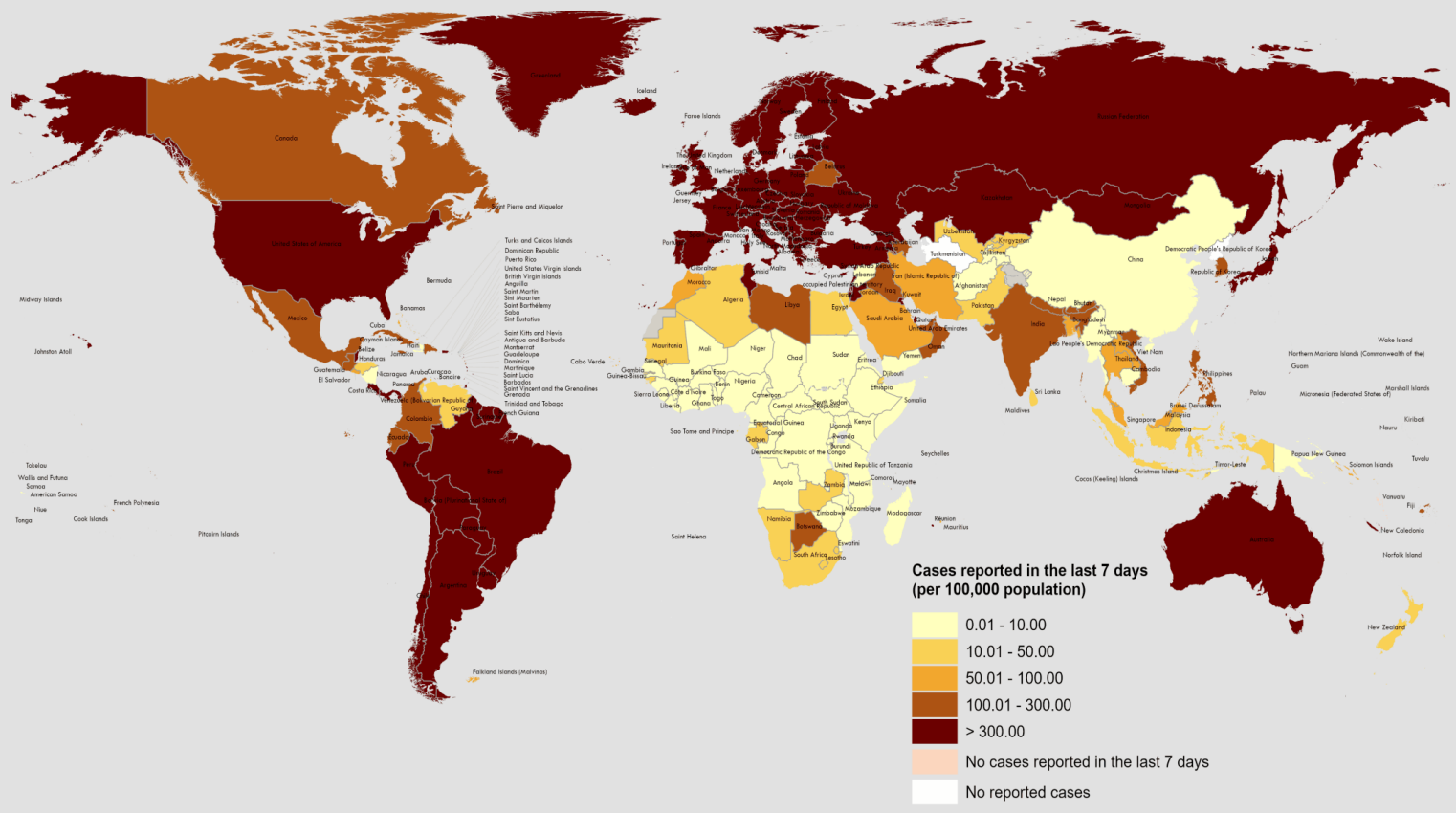
According to Henriksson, with the spread of the Omicron variant, “it appears” that vaccines against the virus do not prevent infections but rather more severe forms of the disease. The Minister emphasised that all restrictions to the rights of people must be proportionate and necessary. “The coronavirus passport limits the basic rights of those people who haven’t got vaccinated, obtained a negative test result, or had the disease. The Coronavirus or vaccination passport isn’t well suited for use in these circumstances because its necessity and proportionality are difficult to justify right now,” the Minister pointed out in this regard.

For those travelling, Stay Safe until the next time.

Total Cases Worldwide – 396,596,256

Total Deaths Worldwide – 5,760,642

Total Recovered Worldwide – 315,336,753

Total Active Cases Worldwide – 75,498,861 (19% of the total cases)

Total Closed Cases Worldwide – 321,097,395

Information and Resources:

https://www.worldometer.info/coronavirus/

https://www.abc.net.au/news/2022-02-07/international-covid-borders-to-reopen-scott-morrison/100810580

https://www.schengenvisainfo.com/news

The Overseas Situation Report Friday 4 February 2022

by Mike Evans

If you’re walking down the right path and you’re willing to keep walking, eventually you’ll make progress.

– Barack Obama

As this report is written at the end of the first month of 2022, I have dedicated this particular report to the latest situation report from the World Health Organisation which details the situation across the world up to the end of January 2022. The reports which come out weekly show a detailed breakdown of each region in the world where the pandemic is prevalent and compares the current situation with a week previous.

Globally, during the week of 24 to 30 January 2022, the number of new COVID-19 cases remained similar to the number reported during the previous week, while the number of new deaths increased by 9%. Across the six WHO regions, over 22 million new cases and over 59 000 new deaths were reported. As of 30 January 2022, over 370 million confirmed cases and over 5.6 million deaths have been reported globally.

At the Regional level, increases in the number of new cases were reported by the Western Pacific (37%) the Eastern Mediterranean (24%) and the European (7%) Regions, while decreases were reported by the Region of the Americas (20%) and the South-East Asia Region (8%). The number of new cases reported in the African Region remained similar to that of the previous week.
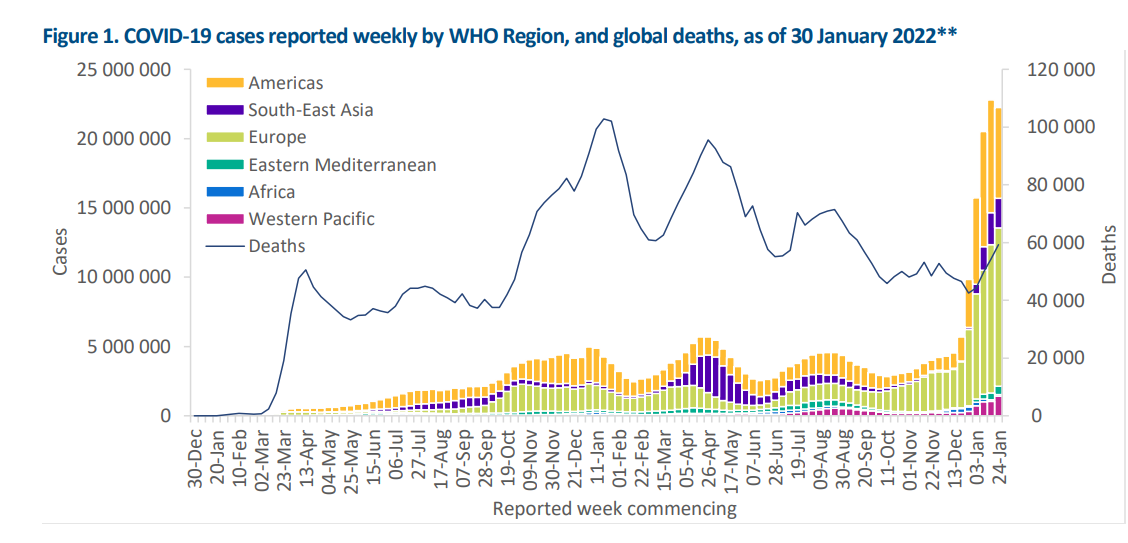
The number of new weekly deaths continued to increase in the South-East Asia Region (41%), the Eastern Mediterranean Region (32%) and the Region of the Americas (16%), while the African Region reported a decrease of 7%. The incidence of deaths remained similar to the previous week in the European and the Western Pacific regions.

At the country level, the highest numbers of new cases were reported from the United States of America (3 279 226 new cases; a 34% decrease), France (2 357 129 new cases; similar to the previous week’s figures), India (1 855 258 new cases; a 12% decrease), Brazil (1 283 024 new cases; a 56% increase), and Germany (1 055 768 new cases; a 48% increase). The highest number of new deaths were reported from the United States of America (13 558 new deaths; a 5% decrease), India (4682 new deaths; a 40% increase), the Russian Federation (4616 new deaths; like the previous week), Brazil (3321 new deaths; an 88% increase) and Italy (2618 new deaths; a 7% increase).

In the Africa Region there were over 125 000 new cases, like the number reported during the previous week. This follows on from a decreasing trend in new cases that has been observed for over a month. However, six countries (12%) reported increases of 20% or greater, with the highest increases reported from the Central African Republic (410 vs 190 new cases, a 116% increase), Lesotho (277 vs 165 new cases, a 68% increase) and Algeria.

The highest numbers of new cases continued to be reported from Réunion (46 914 new cases; 5240.0 new cases per 100 000 population; a 49% increase), South Africa (22 202 new cases; 37.4 new cases per 100 000; similar to the previous week’s figures), and Algeria (14 774 new cases; 33.7 new cases per 100 000; a 63% increase).

The number of new weekly deaths continued to decline in the Region with over 1600 new deaths reported, a 7% decrease as compared to the previous week. The highest numbers of new deaths were reported from South Africa (842 new deaths.
Since mid-January 2022, the Region of the Americas has continued to report a decrease in the number of new cases, with over 6.5 million cases reported this week, a 20% decrease as compared to the previous week.

Only four countries reported increases of 20% or greater including: the Falkland Islands (3 vs 1 new case, a 200% increase), Chile (157 937 vs 82 574 new cases, a 91% increase), El Salvador (6250 vs 3435 new cases, an 82% increase) and Brazil. The highest numbers of new cases were reported from the United States of America (3 279 226 new cases; 990.7 new cases per 100 000; a 34% decrease), Brazil (1 283 024 new cases; 603.6 new cases per 100 000; a 56% increase), and Argentina (619 108 new cases; 1369.8 new cases per 100 000; a 19% decrease).

Over 26,000 new weekly deaths were reported in the Region, corresponding to a 16% increase as compared to the previous week. The highest numbers of new deaths continued to be reported from the United States of America (13 558 new deaths.)

Since the end of December 2021, the Eastern Mediterranean Region reported a continued increase in new cases. During the last week, over 596 000 new cases were reported, a 24% increase as compared to the previous week. Over half of the countries (13/22, 59%) reported increases of 20% or greater, with the highest increases reported from the occupied Palestinian territory (33 080 vs 7293 new cases; 354% increase), the Islamic Republic of Iran and Libya (16 399 vs 6692 new cases; a 145% increase).

The highest numbers of new cases were reported from the Islamic Republic of Iran (76 837 new cases; 91.5 new cases per 100 000; a 189% increase), Jordan (63 153 new cases; 619.0 new cases per 100 000; a 72% increase), and Tunisia (54 346 new cases; 459.8 new cases per 100 000; an 18% decrease). Over 1600 new weekly deaths were reported in the Region, a 32% increase as compared to the previous week.

The highest numbers of new deaths were reported from Tunisia (275 new deaths; 2.3 new deaths per 100 000; a 55% increase).

Since mid-December 2021, the number of new cases has continued to rise in the European Region, with the Region reporting over 11.4 million new cases this week, a 7% increase as compared to the previous week. Twenty-three countries (38%) reported an increase greater than 20%, with the highest increases reported from Armenia (14 722 vs 4094 new cases; a 260% increase), Azerbaijan (19 307 vs 7116 new cases; a 171% increase), and Tajikistan (143 vs 59 new cases; a 142% increase).

The highest numbers of new cases were reported from France (2 357 129 new cases; 3624.2 new cases per 100 000; similar to the previous week’s figures), Germany (1 055 768 new cases; 1269.5 new cases per 100 000; a 48% increase), and Italy (1 040 184 new cases; 1744.1 new cases per 100 000; a 16% decrease). The number of weekly deaths in the Region remained similar to that of the previous week with over 21 000 reported.

The highest numbers of new deaths were reported from the Russian Federation (4616 new deaths; 3.2 new deaths per 100 000; similar to the previous week’s figures), Italy (2618 new deaths; 4.4 new deaths per 100 000; a 7% increase), and France (1881 new deaths; 2.9 new deaths per 100 000; a 19% increase).

Following an increase in the number of new cases over the past month, the number of new cases in the South-East Asia Region decreased, with over 2.1 million new cases reported this week, an 8% decrease as compared to the previous week. However, seven out of ten countries in the region reported an increase greater than 20% in the number of new weekly cases, with the largest increases reported from Timor-Leste (69 vs 5 new cases; a 1280% increase), Indonesia and Bangladesh.

The highest numbers of new cases were reported from India (1,855, 258 new cases; 134.4 new cases per 100 000; a 12% decrease), Bangladesh (100 196 new cases; 60.8 new cases per 100 000; a 49% increase), and Indonesia (56 807 new cases; 20.8 new cases per 100 000; a 286% increase). The number of new deaths in the Region increased by 41% as compared to the previous week, with over 5200 new deaths reported.

The highest numbers of new deaths were reported from India (4682 new deaths; <1 new death per 100 000; a 40% increase).

The number of new cases in Western Pacific Region increased by 37% as compared to the previous week, with over 1.4 million new cases reported. Half of the countries in the Region reported increases of over 20% in new cases, with the highest proportional increases reported from Papua New Guinea (339 vs 81 new cases; a 319% increase), Kiribati (142 vs 39 new cases; a 264% increase) and Palau (1021 vs 319, a 220% increase).

The highest numbers of new cases continued to be reported from Australia (499 935 new cases; 1960.5 new cases per 100 000; a 65% increase), Japan (463 354 new cases; 366.4 new cases per 100 000; a 73% increase), and the Philippines (141 339 new cases; 129.0 new cases per 100 000; a 36% decrease).

The number of new weekly deaths in the Region remained similar to that of the previous week, with over 2500 new deaths reported. The highest numbers of new deaths were reported from Viet Nam (951 new deaths; 1.0 new death per 100 000; an 15% decrease), Australia (565 new deaths; 2.2 new deaths per 100 000; a 31% increase) and the Philippines (465 new deaths; <1 new death per 100 000; a 15% decrease).

It is plain to see that whilst the figures are decreasing across the Globe we are still a fair way away from declaring this pandemic over so until the next time Stay Safe.

Total Cases Worldwide – 386,249,480

Total Deaths Worldwide – 5,721,616

Total Recovered Worldwide – 305,939,021

Total Active Cases Worldwide – 74,588,843 (19.3% of the total cases)

Total Closed Cases Worldwide – 311,660,637

Information and Resources:

https://www.worldometer.info/coronavirus/

https://www.who.int/publications/m/item/weekly-epidemiological-update-on-covid-19—1-february-2022


Madeira Situation Report Wednesday 2nd January 2022

By Daniel Fernandes

Brief Covid-19 update

On Tuesday (February 1st), there were 766 new Covid-19 cases (18 imported cases and 748 cases of local transmission), 1,189 recoveries and 2 deaths in the Region.

There are currently 546 suspected cases, 7,060 active cases (193 imported cases & 6,867 cases of local transmission), 83 patients in hospital (including 4 in intensive care), 14 patients in isolation in a dedicated hotel, and 6,963 patients in isolation in their own accommodation.

As of Tuesday, there had been a total of 64,718 cases, 57,594 recoveries and 164 deaths. 

https://funchalnoticias.net/2022/01/31/drs-da-conta-de-766-novos-casos-de-covid-19-ha-83-pessoas-internadas/

New Covid-19 rules

The Madeira Regional Government announce new and updated Covid-19 rules. These include: 

– The end of mass testing of the population for Covid-19 (applicable since February 1st).

– The end of mandatory weekly Covid-19 testing 

– Only people with Covid-19 symptoms and 38ºC+ fever will be tested. They will merely be advised to be tested. If they are tested, the test will be free of charge.

– A Covid-19 vaccination certificate (certifying inoculation with 3 vaccine doses) must be presented before entry to restaurants, gyms, nightclubs, bars, sporting or cultural events. Alternatively, customers can present evidence of a weekly Covid-19 test. Such Covid-19 test will not be free of charge and must be paid by the customer. It is also possible to present a Covid-19 Recovery Certificate.

– Passengers arriving by air or sea must present a Covid-19 vaccination certificate. If passengers have not been fully vaccinated, they must also present evidence of a rapid Covid-19 test. From Sunday onwards, there will be no more free Covid-19 testing for travellers.

https://funchalnoticias.net/2022/01/31/madeira-acaba-com-testagem-massiva-certificado-de-vacinacao-ou-teste-pago-para-desporto-cultura-e-lazer/

 Hospital visits allowed again

On February 1st, hospital visits were restored after being suspended as a result of the Covid-19 situation in the Region. Hospitalised patients can receive visitors who comply with the SESARAM Contingency Plan. This means visitors must ensure they take a PCR test every week.

It was also requested that the  name of the FAMILIAR DE REFERÊNCIA is provided to the health service. This can be donee at “Balcão do Cidadão”, at the entrance to Hospital Dr. Nélio Mendonça or at the reception of other hospitals.

https://funchalnoticias.net/2022/01/31/visitas-a-doentes-internados-retomadas-amanha-mas-com-obrigatorio-de-teste-pcr-semanal/

Power cut

Empresa de Electricidade da Madeira (Madeira power supplier) announced there will be power cuts due to scheduled work on the electricity supply network. These cannot be postponed and will take place in the following days and places:

FUNCHAL 

February 3rd09h00 to 11h30

– Rua Alferes Fernando Abreu (number 3) 

– Rua de D. João (numbers 22 to 41) 

– Beco do Forno (number 1 to 9)

– Beco do Sardinha (number 1A) 

SERRA DE ÁGUA 

February 4th09h00 to 11h00 

– Poiso

– Estrada Regional 104 (number 374)

CÂMARA DE LOBOS

February 4th13h00 to 14h00 & 16h00 to 17h00 

– Caminho São João (partial)

– Rua José Joaquim da Costa  

– Rua da Quinta do Lagar 

– Travessa das terças

CÂMARA DE LOBOS

February 4th13h30 to 17h00 

– Caminho do Ribeiro Real 

– Caminho do Ernesto Alves Pinto Correia 

– Caminho da Vargem 

– Rua Alferes Manuel Joaquim Lopes 

– Travessa do Ribeiro Real

However, power could be restored during the time frame mentioned above. So, for safety purposes, it should be assumed that there will be power at any time during this period of time.     

If necessary, customers can contact the free Customer Support Service number (Serviço de Apoio ao Cliente): 800 221 187.

https://funchalnoticias.net/2022/02/02/publicidade-o-fornecimento-de-energia-sera-interrompido-nos-dias-horas-e-locais-abaixo-indicados-anuncio-13-2022/


Portugal Situation Report Wednesday 2nd February 2022

Introduction

Good morning – Since the beginning of the year there have been over 700 rural fires of which more than 450 occurred from 28th to 30th January. Over 85% of these recent fires were in the far north. On Friday two fires broke out in hard-to-reach mountain areas and one broke out in a forested area near a village. There were no populations or homes in danger.

The largest of these fires occurred in the Montesinho mountain range, in the district of Bragança, where firefighters, land and air resources were sent at 0800 hrs on Friday, and it was only subdued in the afternoon of the following day. This fire broke out in the Lama Grande area and was the most worrying due to the extent and difficulty in controlling it confirmed the ANEPC. The estimate points to the possible destruction of 2000 hectares in Portugal and Spain, where the fire spread.

Rain has been lacking and the situation of drought in most of the country is reflected in very low levels of relative humidity which, associated with the east wind and the absence of what is called “the nocturnal recovery” of humidity when the sun goes down, leads to an increased  fire hazard  when there is a fire. In fact at the time of the fires on Saturday the Relative humidity levels were as low as 11% in the afternoon in this general area.

For this reason, ANEPC decided on Saturday to prohibit the burning of debris and extensive burns. This was lifted at midnight last night.

Fires in the winter is not very common, but it’s not unheard of either: Having fires in the winter months has to do with weather and climate conditions and there have been years when this has happened.

The situation does not only relate just to an increased fire risk but also water supply. Yesterday Government announced that use of water for electricity production has been suspended at the Alto Lindoso, Touvedo, Vilar-Tabuaço and Cabril/Castelo de Bode dams. At the Bravura dam, in the Algarve, it is no longer possible to use the water for agricultural purposes given the magnitude of the drought.

Turning to Covid-19, a reminder that the Online Vaccination Scheduling Portal is now available to request the scheduling of the first dose of the vaccine against Covid-19, for children aged 5 to 11, so that they can be vaccinated on February 5th and 6th. This can be at the most convenient location, according to the availability and installed capacity of the existing vaccination posts”, according to SPMS in a statement.

The SPMS also added that “children who are eligible for the administration of the second dose, that is, who were vaccinated on December 18 and 19, will receive an SMS with confirmation of the respective schedule”.

Lastly a reminder concerning internet security. This has been in the news over the last two weeks mainly due to the hacking of Expresso and SIC, more recently the alleged attack on the Portuguese Government website and yesterday TAP’s Twitter account. In the case of Expresso and SIC there sites were down for a number of days before temporary sites were established. In the case of the Parliament site this was initially down for only a few minutes and then again for a number of hours for maintenance work on the site to be undertaken.

So I ask this question: If you are operating a business do you have a backup in case your site is either hacked into or goes down for whatever reason? This is worth thinking about, what are the financial implications if this happened to you, and do you have the information available to recreate your site should it not be backed up? Something to check with your hosting company.

With that have a good day.

Headlines

Covid-19: WHO warns it is premature for any country to “declare victory” over coronavirus

The World Health Organization (WHO) warned yesterday that it was premature for any country to “declare victory” over the pandemic, claiming that, since the emergence of the Omicron variant, more than 90 million infections with the SARS-CoV-2 coronavirus have already been recorded.

“It is premature for any country to surrender or declare victory” over the covid-19 pandemic, the WHO director-general said at a press conference, just days after two years had passed since the declaration of a public emergency of international concern. .

According to Tedros Adhanom Ghebreyesus, since the Omicron variant was identified, just 10 weeks ago, almost 90 million cases of infection have been recorded by the organization, “more than was reported in the entire year 2020”.

“We are witnessing a worrying increase in deaths in many regions of the world”, warned Tedros Adhanom Ghebreyesus, who expressed his concern about the “narrative that is taking hold in some countries” that, because of vaccines and the high transmissibility and reduced severity of Omicron, preventing transmission is “no longer possible or necessary” to prevent transmission of the virus.

“Nothing could be further from the truth”, stressed the director-general of the WHO, saying that the organization is not calling for countries to return to confinement, but to “protect their populations using all the tools at their disposal” to combat the disease.

COVID-19 DGS Report Tuesday 1st February

Confirmed: 2,690.690 (+50,888 / +1.93%)

Admitted to hospital: 2,437 (-32 / -1.30%)

Admitted to ICU: 155 (-5 / -3.13%)

Deaths: 19,968 (+63 / +0.32%)

Recovered: 2.078.357 (+44610 / +2.19%)

Active cases: 592,365 (+6215 / +1.04%)

TRENDS

Number of new cases over 50,000 and almost double that of yesterday, but below the highs of last week.

After two days of large increase in hospitalisations a moderate decrease.

A decrease in ICU maintaining an overall stable trend over the last 4 weeks

Marked increase in the number of deaths 14 more than yesterday and 34 more than the day before

A moderate increase in active cases after yesterday’s reduction 

Health

António Costa tests positive for covid on the eve of the meeting with Marcelo

The Prime Minister tested positive for covid-19 in an antigen test. In a statement, António Costa’s office states that the prime minister is doing well and is asymptomatic. According to information, the prime minister has already informed Marcelo Rebelo de Sousa.

The information was meanwhile confirmed by the Prime Minister’s office. In a statement, the cabinet states that “the prime minister carried out a test for covid-19 and had a positive result” in an antigen test. According to the information provided, António Costa is asymptomatic and will serve a seven-day isolation period.

António Costa was to head the Socialist Party (PS) delegation that would be received next Wednesday by the President of the Republic, Marcelo Rebelo de Sousa, in the round of meetings with the parties after the legislative elections.

Covid-19: Death of a 6-year-old in Santa Maria was not due to the vaccine

According to the statement, “the complementary laboratory tests were completed” and sent to the Public Prosecutor’s Office, “on the present date, the autopsy report carried out on January 18 on the 6-year-old child who was admitted to Hospital de Santa Maria”

The National Institute of Legal Medicine and Forensic Sciences concluded that the death of a 6-year-old child at Hospital de Santa Maria was not due to the vaccine against covid-19, according to the results of the autopsy carried out.

“With the knowledge and consent of the Magistrate of the Public Prosecutor’s Office who is in charge of the process, it is reported that the death of the child was not due to vaccination against covid-19. This information has already been transmitted to the child’s family ”, reads a statement from the National Institute of Legal Medicine and Forensic Sciences (INMLCF), released this Tuesday.

According to the statement, “the complementary laboratory tests were completed” and sent to the Public Prosecutor’s Office, “on the present date, the autopsy report carried out on January 18 on the 6-year-old child who was admitted to the Hospital de Santa Maria”.

The INMLCF also states in the statement that, out of respect for the family and for intimacy and private life, “it does not disclose other information of a clinical nature”.

Centro Hospitalar Universitário Lisboa Norte (CHULN) announced on January 17 that a six-year-old boy who tested positive for SARS-CoV-2 had died the day before at Hospital Santa Maria and that the causes of death were being investigated.

Covid-19: BA.2 strain of Omicron variant detected in 57 countries

The BA.2 strain of the Omicron variant, which some studies have shown to be more contagious than the original version, has been detected in 57 countries, the World Health Organization (WHO) revealed this Tuesday.

Omicron, which spreads and mutates rapidly, has become the world’s dominant variant since it was first detected in southern Africa ten weeks ago.

In its weekly epidemiological bulletin, the WHO explained that this variant represents more than 93% of all samples of covid-19 collected in January and has as sub-variants BA.1, BA.1.1 , BA.2 and BA.3.

BA.1 and BA.1.1 – the first versions identified – still constitute more than 96% of the Omicron variant cases recorded in the global GISAID database.

But there is a sharp increase in the number of cases involving the BA.2 lineage, which has several mutations different from the original version, particularly in the binding of the `spike’ protein to human cells.

“The sequences designated BA.2 have been submitted to GISAID by 57 countries to date,” the WHO noted, adding that in some countries this sub-variant now represents more than half of the Omicron samples collected.

The WHO added that little is known about the differences between the sub-variants and called for studies to be carried out on the characteristics of the virus, including its transmissibility, ability to evade immune protections and virulence. 

Covid-19: Immune response is stronger in those who have recovered after a dose of vaccine

A study by the Centro Hospitalar e Universitário de Coimbra (CHUC) confirmed that the immune response is stronger in people who have recovered from covid-19, after a dose of vaccine, than after taking two doses by those who have never been infected.

This is one of the results of a study that the Centro Hospitalar e Universitário de Coimbra (CHUC) has been conducting on the cellular immune response (mediated by T lymphocytes) and mediated by antibodies to the vaccine against covid-19, over time. .

Under analysis were 100 of its employees, 50 of which have never been infected with SARS-CoV-2 and the remaining 50 are people who have recovered from the disease.

According to Artur Paiva, researcher at the CHUC Clinical Pathology Service, “it was confirmed that the immune response is much stronger in individuals recovered from infection after a dose of vaccine, than in naive individuals (who have never been infected by SARS). -CoV-2) after taking two doses”.

“The results obtained in this study, which was accepted for publication in the international scientific journal Clinical and Experimental Medicine, revealed that, six months after infection with SARS-CoV-2, 48 of the 50 participants recovered from the infection maintained protection against the virus, or by the presence of IgG antibodies, or by specific T lymphocytes”, he revealed.

However, “eight of the 50 participants did not have SARS-CoV-2 specific T lymphocytes.”

“This data is relevant, because it has been shown that, in other coronaviruses, it is T lymphocytes that ensure long-term immunity, although it is still unknown whether this circumstance is also valid for SARS-CoV-2”, he added.

Other news

More fires and more area burned in January than in same month 2021

The month of January had more than 500 fires than the same month last year and more than 1,600 hectares of burned area, according to provisional data from the Institute for the Conservation of Nature and Forests (ICNF).

This January, rural fires consumed 3,312 hectares, 1,613 hectares more than in the same period last year, with 717 occurrences being recorded, and 504 more than in 2021.

Provisional data from the Institute for the Conservation of Nature and Forests, covering the month of January (from the 1st to 08:00 on Monday) indicate that 77% of the burned area concerns bush, 22% forest stands and 0% in agriculture.

In January 2021, the ICNF registered 213 rural fires, which resulted in 1,699 hectares of burned area, destroying an area of 1,640 hectares of bush, 55 of forest stands and four of agricultural areas. .

On Saturday, the National Emergency and Civil Protection Authority (ANEPC) banned burning and burning from 00:00 on Sunday and until 23.59 hrs 1St February due to the danger of fire.

ANEPC justifies the decision with the forecast, by the ICNF, of “increased wind intensity that, in combination with the continuation of hot and dry weather, with temperatures above average for this time of year , combined with the number of communications to carry out burning of piles of debris and extensive burns, can give rise to rural fires”.

On Friday, ANEPC registered 132 occurrences related to rural fires in mainland Portugal.

TAP Twitter account was targeted by hackers

TAP confirmed that it had been targeted by hackers. Twitter account has been suspended for prevention

TAP’s Twitter account was the target of unauthorized access by hackers this Tuesday. An information already officially advanced. “TAP confirms that its official Twitter account was the target of a computer attack. The Company has already taken all the necessary steps to protect your account, which is currently suspended.”

The airline’s profile image was modified, with a photograph of a man with a beard and moustache surrounded by white rays and a name: Micheal Sayloor. The hackers also added several tweets with the word “awesome”.

TAP’s communication office does not provide further details, and it is not yet certain whether the cybercrime unit of the Judiciary Police will be investigating the case.

This week, the Parliament website was also the target of a computer attack. Expresso knows that the Judiciary is still trying to understand the scale of the invasion and whether or not there was exfiltration of computer data. The site is currently down so computer experts can run all the tools to investigate the matter.

Fuel consumption increased 19.4% in December

In terms of average selling prices to the public, ERSE notes that Braga, Santarém and Coimbra had the cheapest diesel and gasoline, and Bragança, Beja, Faro and Lisbon the most expensive.

Consumption of oil-derived fuels increased by 102.6 kilotons (kton) in December, year-on-year, which represents an increase of 19.4%, according to data from the Energy Services Regulatory Authority (ERSE), released this Tuesday. .

According to the Fuel and LPG Market Bulletin, for December 2021, “consumption [of oil-derived fuels] in December 2021 was 19.4% higher (102.6 kton) than the same period in 2020”

The most significant increase was seen in the consumption of aircraft fuel (jet fuel), with a year-on-year rise of 77.1%, followed by gasoline (+20.2%) and diesel (+13.8%).

Only the consumption of liquefied petroleum gas (LPG) decreased, by 1.8% in December, compared to the same month of 2020.

Compared to the same period in 2019, before the SARS-CoV-2 pandemic, consumption in December 2021 was 42.7 kton lower, with a decrease in jet (-23.4%), in diesel ( -3.4%) and gasoline (-2.5%) and only an increase in the case of LPG (+3.9%).

Compared to November 2021, global consumption of oil-derived fuels increased by 12.2 kton, which represents an increase of 2%.

In the case of liquefied petroleum gas (LPG), the increase was 23%, for gasoline, 10.4% and for diesel, the growth was 2.3%, compared to the previous month.

Only the consumption of fuel for aircraft (‘jet fuel’) decreased by 13.8% in December, compared to November.


Azores Situation Report Wednesday 2nd February 2022

From our colleague in the Azores

26th January 2022 

1,393 new positive cases of covid-19 were diagnosed, with 802 on the island of São Miguel, 426 on the island of Terceira, 67 on the island of Faial, 39 on the island of Pico, 31 on the island of São Jorge, 18 on the island of Flores, nine on the island of Santa Maria and one on the island of Graciosa, following 4,155 tests carried out.

Recoveries: 

A total of 706 recoveries were registered.

27th January 2022 

1,997 new positive cases of covid-19 were diagnosed, with 1,205 on the island of São Miguel, 586 on the island of Terceira, 57 on the island of São Jorge, 48 on the island of Faial, 43 on the island of Pico, 27 on the island of Santa Maria, 17 on the island of Graciosa and 14 on the island of Flores, following 5,179 tests carried out.

Recoveries: 

A total of 765 recoveries were registered.

28th January 2022.

1,566 new positive cases of covid-19 were diagnosed, with 940 on the island of São Miguel, 442 on the island of Terceira, 72 on the island of São Jorge, 47 on the island of Faial, 29 on the island of Pico, 16 on the island of Graciosa, 10 on the island of Santa Maria and 10 on the island of Flores, following 4,802 tests.

Recoveries: 

A total of 511 recoveries were registered.

Death: 

A 68-year-old woman died from covid-19 on the island of Pico.

She resided in the municipality of Madalena and was not vaccinated.

29th January 2022 

1,387 new positive cases of covid-19 were diagnosed, of which 870 in São Miguel, 272 in Terceira, 75 in São Jorge, 71 in Faial, 59 in Pico, 17 in Graciosa, 12 in Flores and 11 in Santa Maria, resulting from 3,886 analyses.

Recoveries:  

1,103 recoveries were recorded.

Death: 

A 91-year-old man died at the Hospital de Santo Espírito da Terceira, a victim of covid-19. He was a resident of the parish of São Bento, municipality of Angra do Heroísmo. He had been hospitalized since January 15th and was not vaccinated.

30th January 2022 

1,153 new positive cases of covid-19 were diagnosed, with 762 in São Miguel, 247 in Terceira, 59 in Faial, 53 in Pico, 10 in Santa Maria, 8 in Flores, 7 in Graciosa and 7 in São Jorge, resulting from 3,354 analyses.

Recoveries:  

731 recoveries were recorded.

31st January 2022 

939 new positive cases of covid-19 were diagnosed, with 807 on the island of São Miguel, 91 on the island of Terceira, 21 on the island of Graciosa, seven on the island of Flores, five on the island of Pico, four on the island of Santa Maria, three on the island of Faial and one on the island of São Jorge, following 2,266 tests carried out.

Recoveries:  

A total of 330 recoveries were registered.

Death:   

In the last 24 hours, a 77-year-old woman, resident in Lomba da Fazenda, municipality of Nordeste, São Miguel Island, died from covid-19. She had been in the Divino Espírito Santo Hospital in Ponta Delgada since January 28th.

1st February 2022 

1,480 new positive cases of covid-19 were diagnosed, with 1,057 in São Miguel, 279 in Terceira, 65 in Faial, 45 in Pico, 13 in São Jorge, 12 in Flores, six in Graciosa and three in Santa Maria, resulting from 3,457 analyses.

Admissions:         

As of 1st Feb. 53 people are hospitalized, of which 43 are at Hospital do Divino Espírito Santo, in São Miguel (three in intensive care), seven at Hospital de Santo Espírito da Terceira (two in intensive care) and three at Hospital da Horta, in Faial (one in intensive care).

Recoveries:  

479 recoveries were recorded.

Deaths:  

In the last 24 hours, two men died at the Hospital do Divino Espírito Santo, in São Miguel, both living in Água de Pau, in the municipality of Lagoa. One is 83 years old, hospitalized since January 21st, unvaccinated, and another 75 years old, hospitalized since January 24th, with complete primary vaccination.

Current situation:  

The archipelago currently has 13,793 active positive cases, of which 10,745 are in São Miguel, 2,112 in Terceira, 345 in Faial, 259 in Pico, 164 in São Jorge, 93 in Graciosa, 52 in Flores and 23 in Santa Maria.

From 31st December 2020 to 31st January 2020, 207,013 people in the Azores had complete primary vaccination (87.6%) of the population and 85,506 had already received the booster dose (36.2%).

All Covid-19 related information for the Azores Region can be found here:-  https://covid19.azores.gov.pt/


Algarve Situation Report Wednesday 2nd February 2022

Covid-19 Algarve is the mainland region with the fewest new cases of Covid-19, hospitalizations fall

The Algarve is the region of mainland Portugal with the lowest number of new cases of Covid-19 (+1,738), with hospitalizations falling nationally, both in the ward and in Intensive Care Units. The data are from the bulletin of the Directorate-General for Health this Tuesday, February 1st, which has just been released.

Faro postmen advance to partial strike from 1st to 7th February

The mailmen from Faro decided today to carry out a two-hour partial strike between Tuesday 1st and 7th February, to demand “better working conditions”, a union source told Lusa.

The partial stoppage, which will take place daily between 8:30 am and 10:30 am, was decided today in a plenary session of workers at the Postal Distribution Centre (CDP) in Faro, José Oliveira, from the National Union of Postal Workers, and Telecommunications (SNTCT).

“The company did not meet the demands of the workers, that is, the hiring of more professionals to ensure the postal distribution and change the turns, hence the decision to go on strike”, pointed out the union leader.

José Oliveira considered that the company “had enough time to respond to the postmen’s wishes, because the stoppage was announced in a timely manner and changed twice”.

This is the second change in the strike, after, on December 30, also in plenary, workers postponed the strike due to compliance with quarantines due to the covid-19 pandemic, which prevented the holding of a meeting and the compliance with the legally established deadlines to maintain the strike.

“In addition to the lack of people to ensure the distribution service in Faro, the company ended two work contracts a few days ago, which seems to mean that the Faro staff must have a postal service with more quality”, he stated.

According to the leader of the SNTCT, during the period of the strike, the postmen “will be on the street distributing documents to the population, where they explain the refusal to accept the conditions in which they work”.

Free flu vaccine at eight pharmacies in Portimão

Influenza vaccine can be inoculated free of charge at eight pharmacies in Portimão until March 31.

A total of 1800 people from Portimão aged 60 or over, as long as they are users of the National Health Service (SNS), can be vaccinated free of charge against the flu, without the need for a medical prescription, until March 31.

Just go to one of the eight community pharmacies that adhered to the protocol established at the end of 2021 between the municipality of Portimão, the National Association of Pharmacies and Farminveste.

The municipality made available 4,500 euros for the implementation of this protocol, which aims to reinforce the preventive immunization underway at the Portimão Vaccination Centre and in the municipality’s primary health care units.

Free vaccination is maintained for people over six months and under 60 years of age who suffer from chronic diseases, as well as citizens over the age of 65, pregnant women, health professionals, other care providers, firefighters, or professionals from kindergartens, day care centers and the like, as well as staff working in prison establishments.

Bomb threat at Algarve Shopping came from an employee

The bomb threat that occurred on Friday afternoon, at Algarve Shopping, in Guia, Albufeira, came from an employee of the shopping centre, according to Correio da Manhã.

This led to the evacuation of around 300 people, most of them workers at the shopping centre.

The veracity of the bomb threat was eventually ruled out, after an on-site inspection, by the GNR’s explosives inactivation section.

The Judicial Police is investigating the motivations that led to the act. 

Seven-year-old girl dies in accident in Loulé

A seven-year-old girl died on Monday, the victim of a violent accident followed by the overturning of a jeep in Monte da Charneca, parish of Alte, municipality of Loulé.

According to Correio da Manhã, after the alert at 16:54, “the rescue teams found the child in cardiorespiratory arrest, and recovery was not successful”.

The child’s mother, who was not injured, was in the vehicle, confirms the same source.

There were 22 operatives on site, supported by 8 vehicles from the Loulé and Messines Fire Brigade, INEM and GNR.

Maritime Police find six boats fishing in APPA da Armona

Six boats that were fishing in the Pilot Area of ​​Aquaculture Production (APPA) of Armona, where navigation is prohibited, were intercepted yesterday morning by the Maritime Police of Olhão, which issued reports to the non-compliance.

According to the Maritime Authority, in the place where the vessels were detected, there are “establishments for cultures in marine waters” and “navigation is prohibited, except for vessels used by the owners of the establishments located there and surveillance and emergency vessels”.

The authority explains that this area is “duly delimited and marked on nautical charts”.

The Local Command of the Maritime Police of Olhão «will maintain the monitoring and inspection of this area, emphasizing that the presence of vessels in the Armona APPA constitutes a danger for navigation and for the people on board, with the risk of possible damage to the structures of the establishments and damage to the activities carried out there.