Algarve Situation Report Wednesday 25th August 2021


Number of unemployed in Algarve decreases

The number of unemployed registered in July, in the Algarve, decreased 21.5% compared to the same month in 2020, according to data released this Monday, 23 August, by the Employment and Professional Training Institute (IEFP).

According to these figures, at the end of the seventh month of the year, the Algarve had 17,932 unemployed registered with the IEFP services, which also represents a significant decrease compared to the previous month: 2098 people left the Employment Centers between June and July, which equates to a decrease of 10.5% of subscribers.

The recovery of tourist activity is the main responsible for the absorption of these workers by companies. Although recruitment for this sector started later this year, there was a sharp drop in the number of IEFP applicants from May onwards, which continued into June and, it is now known, continued into July [see graph].

If the number of registered unemployed decreased, the number of job offers increased – and a lot – compared to the same month in 2020. At the end of July, there were 1026 job offers, 659 more (+179.6%) than there are one year.

Compared to other regions, the Algarve was the one that had the biggest drop in the number of unemployed compared to last year (-21.5%). It is followed by Alentejo (-15.5%), the Centre (-13.7%), North (-9.5%) and Lisbon and Vale do Tejo (-6.7%). At the national level, the variation was -9.5%.

In the Algarve region, all municipalities had a decrease in the number of registered in July, and Portimão is now the municipality with the highest number of registered unemployed: 3,124. It is followed by Loulé, with 2,800, and Faro, with 2,410.

Municipality of Portimão has already paid 30,000 euros to the victims of the rural fire on July 17

The Municipality of Portimão said in a statement that it has already started payments to victims of forest fires under the emergency fund in the amount of 50,000 euros, created to support needy residents who were affected by the rural fire of 17 July last, that harassed the parish of Mexilhoeira Grande until the following day.

In all, the fire mowed down more than 1600 hectares of bush, pasture, eucalyptus and pine trees in the Gordeiro and Pereira sites, having destroyed the electricity supply and access to water, since it is done through artesian and dams.

Farmers with limited resources, whose activity has special importance and impact on the prevention of rural fires, were affected by the fire.

As a result, the Parish Council of Mexilhoeira Grande carried out a preliminary and provisional survey of the affected residents, as well as the damages and the costs of repairs, having estimated the amount of 50,000 euros, for which 30,000 euros have been paid so far.

The same document states that the monetary support fund provided by the Municipality of Portimão, “aimed at restoring normality and access to basic conditions for the affected population, including support for the replacement of water supply structures in homes and irrigation systems for subsistence agriculture, and the payment of the invoices presented so far is already underway”.


Azores Situation Report Wednesday – 25th August 2021 


From our colleague in the Azores

Covid -19 

Since the last Situation Report a week ago on the 18th of August there have been 195 new cases of Covid-19 registered and 267 recoveries.

According to the Regional Health Authority on the 19th of August there was another death.  It was “a 64-year-old man, resident in Livramento, municipality of Ponta Delgada, who was hospitalized at the Hospital do Divino Espírito Santo, in Ponta Delgada and died from Covid-19 , but he had several comorbidities”.

As of yesterday, 15 patients are hospitalised, all at the Divino Espírito Santo Hospital in Ponta Delgada, with four in Intensive Care Unit.

The archipelago currently registers 372 positive active cases: 325 on the island of São Miguel, 14 on the island of Terceira, 14 on the island of Graciosa, 11 on the island of Faial, five on the island of Santa Maria and three on the island of São Jorge.

Four primary local transmission chains are active in the archipelago: two on the island of Graciosa, one on the island of Faial and one shared between the islands of Faial and São Jorge. To date, 229 have been extinguished on all islands. There are 684 people under active surveillance today.

Since the beginning of the pandemic, 8,585 positive cases of COVID-19 have been diagnosed in the Azores and 8,008 people have recovered from the disease. There have been 41 deaths, 92 people who left the archipelago and 72 cases with history of previous cure. To date, 672,876 tests have been carried out for SARS-CoV-2 virus which causes COVID-19 disease.

From 31st of December 2020 to 16th August, 167,580 people in the Azores have been vaccinated with the first dose (67,9 per cent) and 152,369 with complete vaccination (64,4 per cent), under the Regional Vaccination Plan.

Ship Rescue 

A commercial ship with seven crew members on board, adrift about 6.5 kilometres from the island of São Jorge, in the Azores, due to a breakdown, was rescued today by elements of the captaincy of the port of Horta, according to the authorities.

In a statement, the National Maritime Authority (AMN) said that the seven elements of the adrift ship were doing well, with a malfunction in the ship’s propulsion system having been detected, with water entering the engine room.

The damaged ship was later towed by the pilot vessel of the port authority of the port of Velas, for safety reasons for navigation, to the port of Velas, where it docked at 18:10.

Third Vaccination 

The Government of the Azores is going to start preparing the vaccination process against covid-19 with a third dose for the most vulnerable.

The regional secretary for Health and Sports, Clélio Meneses, said that “it was determined to start preparing the process of vaccination of a third dose to the most vulnerable population”


Overseas Report Monday 23rd August 2021


by Mike Evans

In this report we are looking at how some parts of the world are coping with the increase in cases of the new Delta Variant and also at the situation regarding vaccines across the world.

We start with Canada, With Ontario seeing more than three straight weeks of growth in daily COVID-19 cases — primarily in people who have not been vaccinated — the province is “most definitely” in a fourth wave, says a top doctor with the government’s science advisory table.

And with the number of new cases currently doubling every 10 days, Dr. Peter Juni, scientific director of the science table, warns the province could see as many as 1,200 new cases per day by the time school resumes in less than a month. That’s up from a current average of just over 300. The States Capital, Toronto is in the early days of a fourth wave of COVID-19 fuelled by the Delta variant, and is certain to worsen this autumn, experts say after an almost fivefold jump in daily new infections over one month. The numbers of new cases, hospitalizations and ICU admissions vary widely in different areas of the government’s data. The ministry said it’s due to different data collection and reporting processes. But in general, it shows that roughly 80 per cent of the cases, hospitalizations and ICU admissions are in unvaccinated and partially vaccinated people.

The question on many officials’ minds is how to ensure the city’s high vaccination rate prevents hospitalizations and deaths from surging along with infections, especially among the legions of unvaccinated young schoolchildren headed back to classrooms.

Defences include continued mask rules and, if necessary, shutting schools and businesses to halt outbreaks, said Toronto infectious diseases expert Dr. Anna Banerji. But she said the best defence is vaccine mandates — a measure the Ontario government is so far rejecting.

More than 81 percent of eligible Ontarians have received at least one dose and nearly 72 per cent are fully vaccinated. Moore noted that Ontario is getting close to the thresholds it has set for moving past Step 3, and he expects those targets will be met in a week to 10 days.

Across the world to the country that was at the front when it came to early vaccination of its citizens. Israel, once a global leader in coronavirus containment, has one of the highest daily infection rates in the world.

Nearly one in every 150 people in Israel today has the virus. An average of nearly 7,500 people are infected per day — double the infection rate of two weeks ago. The new surge has Israeli leaders scrambling to bring back mask mandates and restrict gatherings as case rates come close to the worst days of last winter.

Globally, scientists are studying infection rates among Israel’s vaccinated to understand how the vaccine holds up over time. The findings have not been encouraging, setting off a wave of booster panic around the world. Nearly 80% of Israeli adults are fully vaccinated against COVID-19, which constitutes 58% of the country’s relatively young population, according to NPR. Over half of the population was fully vaccinated by March 25, and for a moment, it looked like the country was on its way to herd immunity.

But the rising case rates in Israel may indicate that the protection afforded by vaccines wanes over time. Health officials and Pfizer scientists noted a lapse in protection six to eight months after the second shot, which was timed right around the Delta variant’s arrival in Israel this summer. Half of the seriously ill COVID patients currently hospitalized in Israel were fully vaccinated five or more months ago. Most of them are over 60 years old and have comorbidities, putting them at a higher risk of developing severe illness. Along with renewed efforts to encourage mask-wearing and restrict gatherings, Israel is fighting back the virus by offering booster shots to older adults.

Israel rolled out its booster campaign at the start of August. Adults aged 60 and older who completed their vaccine course at least five months ago are now eligible for a third Pfizer-BioNTech shot. Israel’s move to begin offering boosters set off a wave of wealthy countries doing the same. The US, the UK, Germany, and France are all either prepared or approved to start rolling out booster shots in September. The vaccines are still effective at preventing severe illness, hospitalization, and death due to COVID-19 in most groups, so some experts argue it makes more sense to focus on vaccinating the unvaccinated.

To back up this drive for further vaccinations the authorities this week start a A national antibody survey among 3- to 12-year-olds is slated to kick off on Sunday in municipalities around the country, in a bid to measure the extent to which the coronavirus spread undetected among the country’s children over the past year and a half. The survey is a joint project of the Health Ministry, the Education Ministry and the IDF Home Front Command, with assistance from local authorities and educational institutions. Some 1,400 Home Front Command teams will conduct blood tests at locations around the country, in a bid to reach as many of Israel’s 1.4 million children as possible.

The test is conducted via a finger prick, and provides results within 15 minutes. Unlike previous antibody surveys, which were conducted to learn about asymptomatic infections within crowded communities, this one is supposed to have a concrete and immediate impact on those tested. The assumption is that many children were infected over the past year and a half but showed no symptoms, and therefore were never diagnosed.

Israel’s authorities hope that a significant proportion of children ages 3-12, who are not currently eligible for vaccination, will be found to have antibodies and will thus be eligible for a Green Pass, exempting them from mandatory isolation should they be exposed to someone COVID-positive, and from COVID-19 testing which is now mandatory in order to enter sites and attractions. They will be able to maintain their daily routine, including attending school, and will reduce the burden on the education and healthcare systems. According to data published by the Health Ministry, the number of serious cases increased by 45 and now stands at 666, including 150 in critical condition and 104 on ventilators. On Saturday, 1,467 new cases were recorded, with a positive test rate of 5.11 percent. The COVID-19 infection rate known as the R number – the average number of people each coronavirus carrier infects – dropped to 1.2 and eight people have died from the virus over the weekend.

Finally we turn to the situation regarding vaccines. The head of the World Health Organisation (WHO) called earlier this month for a moratorium on booster doses of COVID-19 vaccines so that those vaccines can be made available to countries that have only been able to inoculate a small proportion of their population.

Dr. Tedros Adhanom Ghebreyesus told reporters that although “hundreds of millions of people are still waiting for their first dose, some rich countries are moving towards booster doses” — a dose to be administered after a full vaccination course. Several countries including France, Germany, and Israel have started administering booster doses. Britain and the US are reportedly considering it as well.

“I understand the concern of all governments to protect their own people from the Delta variant. But we cannot accept countries that have already used most of the global supply of vaccines using even more of it, while the world’s most vulnerable remain protected,” he added. Dr. Tedros also stressed that of the more than 4 billion doses of COVID-19 vaccines administered so far globally, more than 80% had gone to high- and upper-middle-income countries, which account for less than half of the global population.

According to WHO, high-income countries have now administered almost 100 doses for every 100 people, while low-income countries have only been able to administer 1.5 doses for every 100 people.

“We need an urgent reversal, from the majority of vaccines going to high-income countries, to the majority going to low-income countries,” he said. “Accordingly, WHO is calling for a moratorium on boosters until at least the end of September, to enable at least 10% of the population of every country to be vaccinated,” he went on.He highlighted that the world’s 20 biggest economies — collectively known as the G20 — have a “vital leadership role to play, as the countries that are the biggest producers, the biggest consumers and the biggest donors of COVID-19 vaccines.”

WHO officials say the science is unproven about whether giving booster shots to people who have already received two vaccine doses is effective in preventing the spread of the coronavirus.

The WHO has been denouncing the unequal distribution of vaccine doses for months, criticising for instance, countries that have moved to offer the vaccine to all children above the age of 12, when lower-income countries have struggled to immunise their health care professionals.

The UN agency in May set the target of inoculating 10% of the population in every country by the end of September. The WHO chief said Wednesday that “we’re not on track” to reach the target.

The world has a long way to go yet to see the end of this crisis so until the next time Stay Safe.

https://www.haaretz.com/israel-news/israel-kicks-off-covid-antibody-testing-of-1-4-million-children-1.10138637https://www.worldometers.info/coronavirus/weekly-trends/#countrieshttps://www.euronews.com/2021/08/04/who-calls-for-covid-booster-jab-moratorium-to-accelerate-vaccination-in-poorer-countries


Madeira Situation Report Sunday 22nd August 2021


by Daniel Fernandes

 Covid-19 update

There were 165 new Covid-19 cases, 100 recoveries and no deaths from Covid-19 in Madeira since the previous Madeira Situation Report.

On Wednesday, there were 61 new Covid-19 cases (8 imported cases – 3 from the UK, 1 from Spain, 1 from Ukraine and 3 from the Lisbon and Tagus Valley Region & 53 cases of local transmission) and 34 recoveries. This was the highest number of new Covid-19 cases in the Region in a single day since March 2nd. The number of patients in hospital increased to 9, 2 of whom were in intensive care.

On Thursday, there were 47 new Covid-19 cases (7 imported cases – 5 from the UK, 1 from France and 1 from the Lisbon and Tagus Valley Region & 40 cases of local transmission) and 30 recoveries. The number of patients in hospital was 8, with 1 of them in intensive care.

And on Friday, there were 57 new Covid-19 cases (16 imported cases – 12 from the UK, 1 from Spain, 1 from the Azores, 1 from the Lisbon and Tagus Valley and 1 from Northern Region & 41 cases of local transmission) and 36 recoveries. The number of patients in hospital decreased 7, 1 of whom was in intensive care.

There were 373 active cases on Friday, of which 76 had been imported while the other 297 cases had been a result of local transmission. As of Friday, there had been 10,954 cases, 10,506 recoveries and 75 deaths.

On Friday, there were 103 patients in isolation in a dedicated hotel, 263 patients in isolation in their own accommodation and 7 patients in hospital, 1 of whom was in intensive care.

On the same day, there were 162 suspected cases under epidemiological investigation and analysis, which were all linked to patients who tested positive for Covid-19, to calls made to the SRS24 helpline, to referrals by SESARAM (Madeira Regional Health Service) and to airport screening.

There were 45,257 travellers under monitoring by the health authorities. Monitoring is being carried out through the ‘MadeiraSafe’ app. There were also 488 people, who had contact with positive cases, being monitored by the health authorities of several Madeira municipalities and of Porto Santo.

As for Covid-19 testing on passengers who had arrived at Funchal and Porto Santo airports, 292,108 samples had been collected until Friday (at 15h30). By Friday, 579,409 samples from RT-PCR tests had been processed in the Autonomous Region of Madeira.

The SRS 24 helpline (Regional Health Service – 800 24 24 20) received 556 calls from Tuesday to Friday. Overall, it had received 61,357 calls.

The Covid-19 mental health helpline (Linha de Acompanhamento Psicológico da Direção Regional de Saúde – 291 212 399 – available every day from 09h00 to 21h00), which was set up to provide emotional and mental support to anyone in Madeira received 7 calls from Tuesday to Friday. Overall, it has received 3,823 calls.

https://funchalnoticias.net/2021/08/18/novo-coronavirus-53-casos-de-transmissao-local-verificados-hoje/

https://www.jm-madeira.pt/regiao/ver/138375/Covid-19_Regiao_nao_contava_tantos_novos_casos_desde_marco

https://funchalnoticias.net/2021/08/19/47-novos-casos-de-covid-19-30-recuperados-120-suspeitos/

https://funchalnoticias.net/2021/08/20/57-novos-casos-de-covid-19-36-recuperados-162-suspeitos/

Covid-19 vaccination update

According to a real-time Covid-19 vaccination tracker, 76.97% of the Region’s population (193,234) have been administered 1 vaccine dose while 68.39% of the population (171,675) have been fully vaccinated.

https://web.sesaram.pt/COVID19_INFO

50 additional beds available for Covid-19 patients in Porto Santo

Due to the big increase in the number of Covid-19 cases on the island of Porto Santo, the dedicated hotel that was originally being used to ensure isolation of Covid-19 patients is nearly running out beds. As such, a new isolation area that has 50 beds was opened at “Pavilhão Multiusos do Porto Santo”. It has all the necessary conditions to ensure the isolation and well-being of Covid-19 patients. Several entities were involved in setting it up. These include the Madeira Operational Command (Comando Operacional da Madeira) – through the Madeira Military Zone (Zona Militar da Madeira), SESARAM (Madeira Health Service), the Regional Health Directorate (Direção Regional de Saúde), the Regional Civil Protection Service (Serviço Regional de Proteção Civil), the local Health Authority (Autoridade de Saúde), the Municipality and Parish (Autarquia) and the Regional Government (Governo Regional).

https://funchalnoticias.net/2021/08/18/pavilhao-multiusos-no-porto-santo-preparado-para-acolher-doentes-com-covid-19/

Increased Police activity in Porto Santo

The Madeira Regional Government had asked the PSP (Polícia de Segurança Pública – Public Service Police) for additional support in enforcing the Covid-19 pandemic restrictions in Porto Santo after a spike in Covid-19 cases on the island. On Monday, several people were fined for not complying with Covid-19 restrictions. So far, more than 50 fines have been handed out this summer for non-compliance with the pandemic restrictions. Most of those fined have been residents from the island of Madeira.

https://www.jm-madeira.pt/regiao/ver/138230/PSP_ja_esta_mais_ativa_no_Porto_Santo

Indoor adventure park at MadeiraShopping

Visitors to Madeira Shopping will be able to try this activity on the ground floor from August 21st to September 5th. Its opening hours will be: 16h00 to 20h00 from Mondays to Fridays & 11h00-15h00 and 16h00-20h00 during weekends. This activity will be free of charge on a first-come basis and is aimed at children and youths aged 3 to 18. Safety equipment will be provided by its staff.


Traffic restrictions in Funchal

 The Municipality of Funchal informed there will be several traffic restrictions in the following days:

 – 21st and 22nd August (09h00-17h00) – traffic restriction and parking banned at Rua Pedro José de Ornelas, on the stretch between Rua da Pena and Rua de São Jose, due to work on trees.

 – August 21st and September 10th – there will be no road traffic at Rua 5 de Outubro at the junctions with Bairro dos Moinhos, due to paving work.

 – August 22nd – there will be several restrictions in the parish (freguesia) of Monte, due to an athletics event (V Corrida do Caminho de Ferro do Monte).

 – August 24th (09h30-18h00) – there will be no traffic at Azinhaga do Pasto.

 – August 24th (10h00-13h00) – there will be no traffic at Rua de São Filipe, on the stretch between Rua Nova da Alegria and Travessa de São Filipe, due to private building work.

 – August 25th (09h00-16h00) – there will be a traffic restriction at Travessa do Transval.

 https://www.jm-madeira.pt/regiao/ver/138596/Camara_do_Funchal_avisa_sobre_condicionamentos_a_circulacao_rodoviaria


The Overseas Report  Friday 20th August 2021


By Mike Evans

Over the course of the pandemic there have been many conflicting reports that the Main stream media across the world have become mouth pieces for governments as they try to tackle the covid virus with some success and some failure. We can go back as far as 2016 before the pandemic hit the world to see that the term “Fake News” was becoming a regular part of the media reporting. This started when Donald Trump became President of the USA and it has seen a big increase across all the media in the time that the Pandemic has been around.

Whether you believe that the Mainstream media is “in the pockets “ of government or believe in an independent press there are many instances that show up the issues on both sides. The Covid virus has created the perfect conditions for a full scale war on the truth and across the world many politicians are using this to side with the lies.

It’s no surprise that a politician’s worst enemy is a vibrant news media. Journalists who stick their noses into the affairs of the powerful and expose their failures are a threat. It’s therefore no great shock that even many leaders of democratic countries are happier when the press is weakened.

The Covid-19 pandemic has presented a golden window to undermine confidence in the media and, in some cases, for world leaders to launch outright assaults on some of the most respected and important journalistic institutions in their countries.

Earlier this week, the Polish parliament passed a bill that could mean curtains for the country’s largest independent news channel. TVN24, a broadcaster that is frequently critical of the Polish governing party, is in part owned by the American media group Discovery. Should this new bill become law, non-EU entities will be prohibited from being majority shareholders in Polish media companies, meaning Discovery would have to sell its majority stake.

Also this week, Austrian Chancellor Sebastian Kurz put forward his plan that would effectively pull funding from the country’s oldest newspaper.

Wiener Zeitung is a state-owned newspaper and is funded by a model that requires the government to advertise jobs and make other formal announcements in its pages. Yet the paper has an independent editorial policy and has often criticized Kurz and his administration. Under the Chancellor’s plans, that funding would be gone and the paper’s main source of income taken away.

What’s shocking about these two incidents is that they are happening in democratic Western nations. While journalists elsewhere face risk of prosecution or even death threats, the fact this is happening in Europe and is part of a broader trend is seriously concerning for the media and citizens alike.

What has this got to do with coronavirus? Short answer: timing.

“In times of crisis trust in government goes up because people just want somebody to fix things, so you see people rally around the flag,” says Ben Page, chief executive of polling firm Ipsos MORI.

Page says these spikes in support provide a window of opportunity that “distracts from what you are doing elsewhere.” And if you are a politician seeking to capitalize on this, whacking and weakening the press is a relatively easy proposition. “I’m afraid journalism is one of the least-trusted professions all over the world,” he adds.

The reasons for public distrust in journalism are varied. “One of our biggest problems as professional journalists is that all over the world, we have been accused as being part of the system and establishment,” says Pierre Haski, president of Reporters Without Borders (RSF). “So as populist movements grow and rise up against the establishment, they rise up against us.”

Haski thinks that it isn’t just populist movements that present a danger, but also mainstream politicians who are losing voters to more extreme opposition.

He points specifically to an incident in 2018, when French President Emmanuel Macron reportedly said: “We have a press that is no longer pursuing the truth … What I see is the media power that wants to become a judicial power.” The comments came after a member of his security team was caught on camera attacking protesters while off duty.

“In one sentence he delegitimize all media and how we operate. It was eerily close to something Trump might have said,” says Haski.

Haski is, of course, correct to note incidents like this happening before the pandemic. What the coronavirus has provided is a moment in history when a decent chunk of the public is happy with governments behaving in a more authoritarian way, populist leadership is more appealing, accurate information is literally a case of life or death and journalists are not particularly liked.

“As soon as a government decides we are in a crisis and need unity, they can cut the ground under journalists whose job it is to get to the truth because they risk becoming the traitor who is driving the disunity,” says Nic Cheeseman, professor of democracy at Birmingham University.

And this is where the reference to Donald Trump comes to the fore.Even before winning the 2016 election, Trump made slamming the press a central prong of his campaign. And in the years that followed his victory, nearly every negative news story, negative approval rating and election loss was dismissed as “fake news.”

Trump’s attacks on the media intensified during the pandemic. He regularly accused it of overplaying the threat of the virus and seemed to live in a parallel universe when it came to the numbers and science. And when the most important person on the planet does something, others take notice.

According to Rob Mahoney, deputy executive director of the Committee to Protect Journalists. “Donald Trump gave a cue to leaders around the world that attacking the media was now fair game. When he launched attacks on the media (over their coverage) of his shambolic handling of the pandemic, the very moment the public needs as accurate information as possible, leaders in India, Brazil, the Philippines and Western Europe followed suit, denying the severity of the virus to cover their own failures,” he adds.

The question many are asking is what the long-term impact will be, now that going after journalists is routine in so many free, liberal countries.

The industry was already facing a lot of challenges. Proper news is expensive to make and the media landscape has shifted dramatically in ways that have not been easy for journalism.

Modern technology has made it easier for one person sitting at home to run a website that looks as legitimate as that of a centuries-old newspaper. This has created a world in which there is no longer a consensus on facts and a significant number of people are willing to believe things that are simply not true.

This lack of consensus puts journalists who speak truth to power on one side of a debate and lies on the other.

When you put all of this into the context of an unprecedented pandemic, it’s easy to see why the past 18 months have been an ideal time for leaders to pick a side.

And as we emerge from this crisis into whatever the new normal looks like, leaders who decided to side with lies will be remembered by everyone and, to some extent, will determine what that new normal is.

Until the next time Stay Safe.


Madeira Situation Report Wednesday 18th August 2021


By Daniel Fernandes

There were 246 new Covid-19 cases, 187 recoveries and no deaths from Covid-19 in Madeira since the previous Madeira Situation Report. On Wednesday, there were 30 new Covid-19 cases (3 imported cases – 1 from Florida, 1 from the UK and 1 from the Lisbon and Tagus Valley Region & 27 cases of local transmission) and 23 recoveries. The number of patients in hospital increased to 8, 1 of whom was in intensive care.
On Thursday, there were 31 new Covid-19 cases (3 imported cases from the UK & 28 cases of local transmission) and 27 recoveries. The number of patients in hospital decreased to 7 and no patients were in intensive care.
On Friday, there were 45 new Covid-19 cases (11 imported cases – 5 from the UK, 3 from the Lisbon and Tagus Valley Region, 2 from Southern Region and 1 from the Azores & 34 cases of local transmission) and 14 recoveries. The number of patients in hospital increased 9 and no patients were in intensive care.
On Saturday, there were 39 new Covid-19 cases (7 imported cases – 1 from France and 6 from the Lisbon and Tagus Valley Region & 32 cases of local transmission) and 33 recoveries. The number of patients in hospital remained the same as the day before.
On Sunday, there were 42 new Covid-19 cases (7 imported cases – 2 from the UK, 1 from Russia and 4 from the Lisbon and Tagus Valley Region & 35 cases of local transmission) and 24 recoveries. The number of patients in hospital remained the same, although there was 1 patient in intensive care.
On Monday, there were 34 new Covid-19 cases (7 imported cases – 2 from France, 1 from Spain, 1 from the Netherlands, 1 from the UK and 2 from the Lisbon and Tagus Valley Region & 27 cases of local transmission) and 36 recoveries. The number of patients in hospital decreased to 7, 1 of whom was in intensive care.
And on Tuesday, there were 25 new Covid-19 cases (9 imported cases – 3 from the UK, 2 from Switzerland, 2 from Ukraine and 2 from the Lisbon and Tagus Valley Region & 16 cases of local transmission) and 30 recoveries. The number of patients in hospital increased to 10, 2 of whom were in intensive care.

There were 308 active cases on Tuesday, of which 58 had been imported while the other 250 cases had been a result of local transmission. As of Tuesday, there had been 10,789 cases, 10,406 recoveries and 75 deaths.
On Tuesday, there were 69 patients in isolation in a dedicated hotel, 229 patients in isolation in their own accommodation and 10 patients in hospital, 2 of whom were in intensive care.
On the same day, there were 175 suspected cases under epidemiological investigation and analysis, which were all linked to patients who tested positive for Covid-19, to calls made to the SRS24 helpline, to referrals by SESARAM (Madeira Regional Health Service) and to airport screening.
There were 45,672 travellers under monitoring by the health authorities. Monitoring is being carried out through the ‘MadeiraSafe’ app. There were also 590 people, who had contact with positive cases, being monitored by the health authorities of several Madeira municipalities and of Porto Santo.


As for Covid-19 testing on passengers who had arrived at Funchal and Porto Santo airports, 289,959 samples had been collected until Tuesday (at 15h30). By Tuesday, 573,627 samples from RT-PCR tests had been processed in the Autonomous Region of Madeira.

The SRS 24 helpline (Regional Health Service – 800 24 24 20) received 1,009 calls in the last 7 days. Overall, it had received 60,801 calls.

The Covid-19 mental health helpline (Linha de Acompanhamento Psicológico da Direção Regional de Saúde – 291 212 399 – available every day from 09h00 to 21h00), which was set up to provide emotional and mental support to anyone in Madeira received 15 calls in the last 7 days. Overall, it has received 3,816 calls.
https://funchalnoticias.net/2021/08/11/30-novos-casos-de-covid-19-23-recuperados-98-suspeitos/

https://funchalnoticias.net/2021/08/12/31-novos-casos-de-covid-19-27-recuperados-91-suspeitos/

https://funchalnoticias.net/2021/08/13/45-novos-casos-de-covid-19-14-recuperados-131-suspeitos/

https://funchalnoticias.net/2021/08/14/39-novos-casos-de-covid-19-reflectem-tendencia-para-aumento-da-transmissao-local/

https://funchalnoticias.net/2021/08/15/42-novos-casos-de-covid-19-hoje-na-ram-24-recuperados-31-suspeitos/

https://funchalnoticias.net/2021/08/16/34-novos-casos-de-covid-19-36-recuperados-68-suspeitos/

https://funchalnoticias.net/2021/08/17/25-novos-casos-de-covid-19-hoje-30-recuperados-175-suspeitos/

Covid-19 vaccination update

As of August 15th, a total of 340,605 Covid-19 vaccine doses (189,763 1st doses & 167,012 2nd doses/full vaccinations) had been administered in the Autonomous Region of Madeira since the start of the Covid-19 vaccination campaign on December 31st. This means that by that day, 75% of the archipelago’s population had been administered the 1st vaccine dose and 66% of the population had been fully vaccinated. A total of of 16,063 Covid-19 vaccine doses (6,737 1st doses & 10,948 2nd doses/full vaccinations) were administered in the week before August 15th.
The plan for this week is to continue to administer Covid-19 vaccines throughout the Region. The highlight will be the inoculation of youths (aged 12 or above) in all vaccination centres.
Two shipments of Pfizer Covid-19 vaccines arrived in Funchal (15,000 doses on August 12th & 17,550 doses on August 14th). These shipments will allow the regional Covid-19 vaccination campaign to continue.

According to a real-time Covid-19 vaccination tracker, 76.03% of the Region’s population have been administered 1 vaccine dose while 66.94% of the population have been fully vaccinated.

https://funchalnoticias.net/2021/08/17/66-por-cento-da-populacao-da-ram-ja-tem-a-vacinacao-completa-contra-a-covid-19/

https://funchalnoticias.net/2021/08/12/mais-15-mil-vacinas-da-pfizer-chegaram-hoje-a-regiao/

https://funchalnoticias.net/2021/08/14/mais-17-550-vacinas-da-pfizer-chegaram-hoje-a-regiao/

https://web.sesaram.pt/COVID19_INFO


Warning on growing number of Covid-19 cases in Porto Santo

The number of Covid-19 cases has been growing on the island of Porto Santo. On August 15th, there were 49 active cases on the island and only 2 of them were from Porto Santo residents. The average age of those infected is 16-17 and most of them are on the island without their parents. Rogério Correia, the island’s health delegate, severely criticised their behaviour and appealed for parents to “control” their children. He said most of them are on the island without their parents.

And Miguel Albuquerque, the President of Madeira’s Regional Government, acknowledged the situation on the island is “complicated”. He has asked the Police to reinforce compliance with the rules on distancing, the use of face masks and the curfew, and warned that more fines will be handed out for non-compliance. He fears the Porto Santo population, businesses and businesspeople will be affected if the Covid-19 situation worsens and said Funchal is already being affected by the outbreak in Porto Santo.

Despite the current Covid-19 situation in Porto Santo, Albuquerque assured the situation is under control and that there is no need to introduce additional policies and restrictions, the chains of transmission are being monitored and some families have even had their holidays ruined due to mandatory isolation. He highlighted the low number of patients in hospital and the growing rate of Covid-19 vaccination among young people.

https://www.jm-madeira.pt/regiao/ver/138018/Casos_de_covid-19_disparam_no_Porto_Santo_

https://www.jm-madeira.pt/regiao/ver/138089/Governo_Regional_admite_reforco_de_multas_para_quem_nao_cumprir_medidas

https://www.jm-madeira.pt/regiao/ver/138020/Miguel_Albuquerque_aborda_pandemia_no_Porto_Santo_Fazem_festas_privadas_e_e_dificil


Extra ferry services between Madeira and Porto Santo

Porto Santo Line (a ferry company) announced it will have extra ferry services connecting the islands of Madeira and Porto Santo on September 1st. The aim is to allow passengers to have more time to enjoy their stay in Porto Santo. This will be the timetable on September 1st:
Funchal – Porto Santo: 08h00 & 15h00 (extra service)
Porto Santo – Funchal: 11h30 (extra service) & 19h00
Passengers can amend their reservations at no additional cost by visiting one of the branches:
– Avenida do Mar e das Comunidades Madeirenses, number 20, Funchal – Monday to Friday (08h30-18h00 & Saturday (09h00-13h00)- Estrada Monumental, number 175 C, Funchal – Monday to Sunday (09h00-12h30 & 14h00-20h00)
– Rua D. Estevão de Alencastre, Loja 6/7, Porto Santo – Mondato to Friday (09h00-12h30 & 14h00-18h00)

Alternatively, passengers can also call 291 210 300 (Monday to Friday – 09h00-12h30 & 14h00-18h00) or email infopsl@gruposousa.pt

https://funchalnoticias.net/2021/08/17/porto-santo-line-abre-viagens-extraordinarias-a-1-de-setembro/


Around 250 personnel deployed to respond to potential forest fires

On August 16th, around 250 personnel had been deployed in order to be ready to respond to potential forest fires. There were 24 fire vehicles crewed by 3 people and each surveillance tower was manned by 2 people. There were patrol teams in each municipality. In addition, several entrances to mountain and leisure areas were closed.

https://www.jm-madeira.pt/regiao/ver/138091/Protecao_civil_tem_cerca_de_250_operacionais_no_terreno_prontos_a_responder_a_qualquer_ocorrencia


Power cut
Empresa de Electricidade da Madeira (Madeira power supplier) announced there will be power cuts due to planned work on the electricity supply network. These works cannot be postponed and will take place in the following day and places:
CAMPANÁRIO
August 20th – 09h00 to 12h00
– Pinheiro (partial)
– Estrada do Pedregal (between number 1 and number 26)
– Rua Comandante Camacho de Freitas (between number 552 and 1070)
FUNCHAL
August 21st – 14h00 to 19h00
– Avenida do Mar e das Comunidades Madeirenses, 32 (NOS & MEO)

However, power could be restored during the time frame mentioned above. So, for safety purposes, it should be assumed that there will be power at any time during this period of time.

If necessary, customers can contact the free Customer Support Service (Serviço de Apoio ao Cliente): 800 221 187.

https://funchalnoticias.net/2021/08/18/publicidade-o-fornecimento-de-energia-sera-interrompido-nos-dias-horas-e-locais-abaixo-indicados-anuncio-69-2021/


Algarve Situation Report Wednesday 18th August 2021


Pioneer serological study started in homes in Algarve and Alentejo

5200 people, including 2400 employees and 2800 users, from 62 nursing homes in the Algarve and Alentejo started this Tuesday, the 17th, to undergo the serological test, which will determine the «prevalence of positive antibodies, 8 months after the vaccination’ against Covid-19.

For 10 days, teams from the Algarve Biomedical Center (ABC) will run institutions, «from Vila Real de Santo António to Vila do Bispo, in Algarve, and from Odemira to Portalegre, in Alentejo», to carry out these tests. The serological study is voluntary and free of charge. A little prick on the finger to collect the blood and that’s it.
The operation began yesterday, at the Sagres home of Santa Casa da Misericórdia in Vila do Bispo, with the presence of Minister Ana Mendes Godinho, responsible for the Ministry of Work, Solidarity and Social Security. Results will be presented in September.

Speaking to Sul Informação , Nuno Marques, president of ABC, explained that what will be done are tests «on a group of elderly people over 80 years old, who are the people who are in the homes, and, at the same time, the employees of these homes, younger’, only being included ‘people who have been fully vaccinated to date’.

The serological study, added that responsible, “will make the comparison of these two groups, since it is already known that the elderly always have a weaker immune system”, being “often excluded from scientific studies”, which leads to that there is “very little data on this population”.

In other words, this serological study will analyze the immunity of the most vulnerable elderly who have already been vaccinated and compare it with that of employees who received the vaccine at the same time.


Algarve tourism in Germany to captivate luxury tourists

During this week, from the 15th to the 18th of August, the Algarve Tourism Association (ATA) is participating in the Loop Summer 2021, the most recognized Luxury Travel Show exclusively aimed at markets such as Germany, Austria and Switzerland.

Taking place in Frankfurt, Germany, the event brings together the main agents in the sector dedicated to the luxury tourism segment, with the aim of promoting, over the three days, strategic business meetings and networking moments among the participants.

In a statement, the ATA informs that the promotion of the region among travellers looking for «quality, exclusivity and differentiating experiences» has been one of the bets of Turismo do Algarve, with a view to the sustainable development of the region as a tourist destination.

“We have been intensifying the effort to attract tourists from a medium/high segment, with purchasing power, who appreciate a more sustainable tourism and less sensitive to the price factor”, explains João Fernandes, president of Turismo do Algarve. “The presence at Loop Summer 2021, where we are participating for the first time, assumes, therefore, a strategic relevance, considering that it allows us to contact directly with travel agencies and tour operators specialized in this type of tourism and that work with the market Germany, the second most expressive foreign market for our region, after the United Kingdom,” he adds.

Seniors living alone safer with technology “made in Portimão”

Elderly people who live alone are now more protected and safer with technology “made in Portimão”. click2care tele-assistance system will be offered to 30 seniors from Portimão.

The Municipality of Portimão is proceeding with the free delivery of 30 tele-assistance devices, through the click2care system, to elderly people who were identified by the services of the Health and Citizenship Unit of the municipality because they live in a situation of isolation and without a support network, meager economic income, with this group being monitored in social housing, community centers and senior social centers in the municipality of Portimão and in the GAPI – Support Group for the Elderly.

According to Teresa Mendes, councillor with the responsibility for Social Action and Health at the Portimão Council, “the support that should be given to these people, who normally live alone at home, is essential due to the hectic life that family members have, that prevents the necessary support. Therefore, this tele-assistance system becomes a great asset in emergency situations, allowing them greater proximity and a feeling of security».

In the view of the local authority, who delivered some equipment in person, “it is imperative that our seniors can resort to quick help whenever something happens to them while they are alone, and for this we have established a partnership with the company Tecnologias Imaginadas, who grew up at StartUp Portimão»?


«The municipality of Portimão assumes in full the costs inherent to this very useful service for the 30 seniors covered in this first phase, having already signed a 24-month contract. We believe that the amount involved (13,702.80 euros) is by no means an expense, but an investment, because this back-up support provides the appropriate social response to a gap that was felt», stresses Teresa Mendes.


Portugal Situation Report Wednesday 18th August 2021


By David Thomas, President Safe Communities Portugal

Good morning – This morning we are only producing general reports for Madeira, Azores and Algarve due the fire at Castro Marim over the last two days. This Portugal report will therefore focus on important points concerning prevention, self-protection and reporting of fires, as this a high priority at present.

The fire in Castro Marim (or had it been anywhere else in the Algarve) was not unexpected, given the weather conditions.

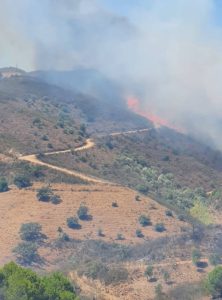
Although relatively few fires start at 01.00 hrs in the morning, this one did and spread fairly quickly. Being at night time, air means could not be deployed and for fire fighters on the ground access was extremely difficult, resulting in the fire to spread quickly driven by moderate winds. It was brought under control early on 16th, but re-ignited and is now under conclusion. Our major incident page here has all the updates.

OUR ROLE

Our role at Safe Communities, as it was when I spent over 30 years as a police officer, is to protect life and property. For that reason SCP trained for and became Portugal’s only Civil Protection Voluntary Organisation under Portuguese law in the area of communication in particular to the international community living and visiting here.

We attended numerous civil protection exercises, visited command posts during incidents, and entered into formal agreements with the ANEPC, as well as becoming part of the National Civil Protection plan, plus working closely with fire behavioural experts. As such in times of crisis we can call upon the relevant authorities for guidance, advice and information when required as in carrying out our statutory duties. As a legal entity we can provide advice; whereas many other try to do so, with no accepted qualification in Portugal to do so. When you see this on social media please therefore take care.

PREVENTION AND SELF-PROTECTION

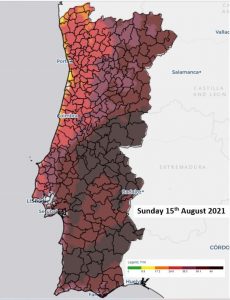
In the weeks leading up to the Castro Marim fire we have been posting both the normal fire risk map and chart, as well as the rural fire hazard in other words the FWI.  With the latter we have drawn comparisons with the Monchique fire of 2018 as the current conditions are similar with the FWI then, which determine how quickly fires can start and spread, at Extreme 64 and above.
With these reports we have added links to our website and provided information on self-protection in the event of fires. I hope you seen these, shared this information, and are by now fully aware of what steps to take should a fire approach your home.

Judging by the number of shares and reaches on our Facebook page, what it shows is that fires themselves once started, become far more newsworthy and are as consequence shared more widely, well beyond the communities affected. If preventive advice was as widely shared, people would become more informed and the risk of fires would decrease, because behaviour would change.

I give an example; yesterday we published posts cornering the dangers of smoke and the importance of self-protection and they were widely shared, simply because a major fire was taking place, and for some people it had unfortunately become a reality.

It is easy to become complacent and think “well it will never happen to me”, but in doing this, one can become exposed to danger, due to not understanding the risks. In extreme cases the consequences could be fatal. If you have every experienced a fire you will know that fires can burn with great intensity and spread very quickly. It was reported that at one stage the Castro Marim fire was consuming some 650 hectares an hour! In these situations there is no time to make plans, so it is important to plan well ahead.

WHY SELF-PROTECTION IS NECESSARY

The second point I wish to make is that fire fighters may not always be able to reach you quickly should a fire approach your home. This could be due to difficulty of access in isolated areas, with no proper roads, especially at night time, or during a major fire covering a large area with a long perimeter. In the Castro Marim fire yesterday the perimeter was stated at 43 Kms! At some stages yesterday some 600+ fire fighters were deployed.  However, not all of those are actively fighting fires!  For example the total includes drivers, logistics, those taking a well-deserved rest, meal breaks, change of shift for example – so for all these reasons in a large fire you may find yourself alone for a period of time. Learning about self-protection is therefore vitally import ant.

When you next see our messages on this subject please share, because by doing so you are helping others.

REPORTING OF FIRES

Each day at this time of the year there can upwards of around 40 fires sometimes reaching over one hundred. This is too many, but a vast reduction compared to over 300 per day during the worst of the 2017 fire period. The vast majority of rural fires take place in isolated areas and do not pose a threat to life or property, and the vast majority are extinguished quickly, normally within one hour due to the great work of the emergency services.

These fires are monitored by Civil Protection through their dashboard and through Fogos.pt https://fogos.pt/ which has an automatic link to the ANEPC dashboard downloading information, but with more features, including location maps. This is important as it ensures accuracy, and avoids human error. We have been requesting for some time to the ANEPC headquarters for more information concerning fires particularly maps showing the extent of areas burned, and the direction of active fires etc. We are very pleased therefore that starting recently this is now being done.

Although we monitor all rural fires, we do not report each and every one, such as stating the number of operatives, vehicles and aircraft as that alone provides very little information concerning the fire situation, especially where exactly the fire is and which direction it is moving in for example. Our criterial for creating SITREPS (situation reports), is when the fires has exceed the initial attack stage; and or if it poses a threat to life or property; it becomes a major incident declared by the ANEPC or there multiple fires in a close area. In such cases we create a Facebook post updated regularly, linked to a major incident page (in serious cases) on our website with as much relevant and accurate information available.

This ensures that there is a proper audit of communication from start to finish in major incidents, as well as consistency in reporting using a well-defined criteria.

We thank our colleagues at Brits in Portugal, various organisations and groups for sharing this important safety information.

Have a Safe Day.


Azores Situation Report  Wednesday 18th August 2021


From our colleague in the Azores


Covid -19 

Since the last Situation Report a week ago on the 11th of August there have been 260 new cases of Covid-19 registered and 354 recoveries.

Another death has been registered in São Miguel, an 87-year-old woman who was admitted to the Hospital do Divino Espírito Santo. She was resident in the parish of Remedios, municipality of Ponta Delgada.

The archipelago currently registers 456 positive active cases: 386 on the island of São Miguel, 28 on the island of Terceira, 17 on the island of São Jorge, 10 on the island of Faial, seven on the island of Santa Maria, six on the island of Graciosa and two on the island of Pico.

Since the beginning of the pandemic, 8,390 cases of COVID-19 have been positively positive in the Azores and 7,737 people recovered from the disease. There were 39 deaths, 89 people who left the archipelago and 69 with history of previous cure. To date, 666,197 tests have been carried out for SARS-CoV-2 virus which causes COVID-19 disease.

Nearly two thirds of the region’s population have been vaccinated with two doses or a complete single dose of a vaccine. From 31st of December 2020 to 16th of August, 167,580 people have been vaccinated in the Azores with the first dose (67.9 per cent) and 152,369 with complete vaccination (64.4 per cent), under the Regional Vaccination Plan.

New Doctors 

The Regional Government of the Azores is hiring of 24 general and family medicine doctors for the Region, eight for São Miguel, six for Terceira, five for São Jorge, two for Santa Maria, two for Pico and one for Graciosa .

The Regional Secretary for Health and Sports, Clélio Meneses, said that it is “before the implementation of the purposes of this Government in order to provide the Health Units of the Region with doctors that allow for a closer and more effective response” to the populations.

“We were faced with major response problems at this level on several islands and in some locations, particularly, so we have to make a great effort to recover the Regional Health Service from these difficulties that, unfortunately, have affected the Azorean people”.

New ship for Corvo 

The island of Corvo has received, for the first time, the ship “Thor Assister”, under the contract for the regular maritime transport service of goods between Faial-Corvo-Flores-Faial.

The Regional Secretariat for Transport, Tourism and Energy clarifies that, during the past weekend, the dredging works of the Porto da Casa were completed, in order to guarantee the necessary conditions for this new operation.

This operation will allow for greater regularity and reliability in the supply of Flores and Corvo, allowing the arrival of different types of essential and non-essential goods, and minimizing constraints that have persisted for several years.

Despite the relevance of the moment and the expectations placed on the entire operation, the transport authority in the Region will remain permanently committed to promoting social and territorial cohesion in the Autonomous Region of the Azores.


The Overseas Situation Report Friday 13 August 2021

by Mike Evans

“Gender equality in Latin America is not only a human right, it is good economic practice.”

– Rosario Perez, President & CEO, Pro Mujer

The pandemic has caused a complete change in many peoples’ working practice from being furloughed for a year to working from home and to being on short hours contracts.

For some the prospect of finding work again after their business has gone bust or have downsized is a prospect many fear.  None more so than in Latin America where the pandemic has been particularly hard on the poorer countries.

As the pandemic drags on, Latin American women fear they are losing even more ground as the COVID-19 pandemic threatens to worsen existing gender gaps, exacerbate precarious labour conditions and erase progress made by Latin American women workers.

In Bogota, Columbia, Elcy Gomez’s monthly rent cheque has turned into a ticking time bomb. The mother of three was just starting her own herbal medicine business when the coronavirus pandemic hit. As COVID-19 lockdowns in Bogota stretched on, her work evaporated, plunging her family into debt. With a diabetic husband and children in their early 20s just entering the workforce, Gomez shouldered most of the economic burden. For a year and a half, her family has scraped together small sums of money, just enough to pay for their small apartment in the far reaches of the city and put food on the table.

Gomez’s stress is etched on her 55-year-old face, and her situation hasn’t gotten better as the pandemic wears on. When her latest rent cheque was due on August 4, she said she didn’t even have the first 100,000 pesos ($25) to put towards it. The apartment costs $200 per month. “We don’t have anything right now to pay our bills, Until now, we haven’t been able to get anything.”

She begged her landlord to give her more time to pay, just as she’s had to routinely do over the course of the pandemic. Gomez fell eight months behind on rent payment at her last apartment before moving to this one, which is cheaper — but she is still struggling to scrape together the money.

Gomez is not alone. Low coronavirus vaccination rates — combined with some of the highest infection rates in the world — threaten to prolong the economic crisis caused by the pandemic in Latin America, and push the region into what the International Monetary Fund and other authorities warn could become a “lost decade”.

Women, who have always suffered more precarious labour conditions, are among the most disproportionately affected by that turmoil. Experts worry that the pandemic is not only deepening endemic gaps, but also setting women back in years of progress in a region that already lags behind on gender equality.

“With working women, the pandemic not only affected them by worsening structural problems they already faced; it also created new risks,” said Maria Adelaida Palacio, a leader at the Bogota-based feminist research group Sisma Mujer. The root of the problem comes from structural inequalities that stretch back far before the health crisis, explained Palacio. The pay gap between men and women across the region already stood at 17 percent on average for each hour worked pre-COVID, United Nations figures show.

Yet the 30 years leading up to the pandemic were marked by the exponential growth of women entering the workforce in the region. Gomez was among the women who felt like they were making strides as she launched her new business and began social work projects in other areas of the country.

“We [women] were the ones who were going to lead the orchestra, as I like to say,” she remembered. “But we couldn’t because of the pandemic. It was like an illusion. Like I thought I could do something, but in reality, no.”

It was a far cry from where she had been decades earlier, when she landed in Bogota after being forcibly displaced by armed-group violence in her home in the Cesar region in northern Colombia.

More than half of the women in Latin America work informal jobs – like selling food on the streets or doing gig work that doesn’t have guaranteed labour conditions or steady pay – and work those jobs at a higher rate than their male counterparts, data from the International Labour Organization shows.

Women also work in sectors – hotels, restaurants and domestic work – disproportionately affected by the pandemic in higher frequencies than men.

Left unemployed, many mothers have been forced to “carry the burdens” of childcare and household duties, effectively returning to the “traditional” roles they had been emerging from, Palacio said. In Colombia, levels of unemployment among women were already higher than those of men, pre-pandemic. In January 2020, 10.4 percent of Colombian men were unemployed compared to 16.5 percent of women, according to a report by Sisma Mujer citing Colombian government data.

A year later, that gap had only widened. Unemployment jumped across the board, but while it jumped to 13.4 percent for men in January 2021, it jumped to 22.7 percent for women, the report found.

Gomez’s 21-year-old daughter is among the women who have felt those effects. Pre-pandemic, Mariela Alfaro Serna worked as a live-in nanny for 500,000 pesos ($125) a month, working at least six days a week. She didn’t like the work and it paid poorly, but it kept her afloat while she was studying to get a certificate in systems engineering.

She left the job after earning the certificate at the end of 2019, hopeful it would mean she could enter the formal workforce. When the pandemic hit, she was left without employment in the sector she studied or the domestic work she once depended on. A year after she left, the family that had hired her as a nanny called her again, offering her work to care for their child as they reopened their restaurant.

But there was a catch: they were only going to pay her what she considered “slave” pay. “I went back, but it was even worse. I would earn only whatever they wanted to give me, 100,000 ($25) a month, or maybe 150,000 ($38)” she described. “Eventually I said ‘no.” She took the job to help her family, as her mom struggled to find small social-work jobs to pay rent and the debt from her failed herbal medicine business, and as her older brother would take periodic work as a motorcycle taxi driver.

Now, she bakes desserts and sells them to neighbours to help chip away at the bills. “I try to earn as much as I can a month so I can give my mom at least half or a bit more,” she said.

Still, the family has had to move to a lower-priced apartment and the internet and power periodically get shut off, depending on how the month has been.

The phenomenon is not just happening in Colombia. Arussi Unda, a well-known leader in the Mexican feminist group Las Brujas del Mar, said women in Mexico face similar challenges.

She noted that her organisation, based in Veracruz, Mexico, has seen more women who are unable to find work resorting to prostitution and survival sex. Unda also worries the economic hit will continue to fuel domestic violence, which has increased in Colombia — and globally — since the beginning of the pandemic.

“Women have less resources to get out of cycles of violence,” Unda explained. Sisma Mujer and other women’s organisations in Colombia have raised similar concerns

Even as Colombia’s economy recovers, the fallout poses a long-term risk for women, warned Palacio of Sisma Mujer, noting that it could easily push women into more precarious working conditions and leave jobless women behind as men return to work.

“The risk is that the equality gap only deepens, and we have a society where every day, women become more impoverished,” she said. At the same time, Palacio also views this as an opportunity. If regional and international entities act intentionally, economic recovery could hold “great potential for women”, she said.

“Now with the economic reactivation, what we have to think about is: ‘How do we formalise women’s contracts? How do we guarantee that women don’t return to the same precarious working conditions?’” she said.

But 52-year-old house cleaner Rosa Beltran believes it’s more complicated than that. Beltran began working as a house cleaner in Bogota, Colombia in 2008 after her husband left her and she had to care for three children.

For years, she applied for office jobs, but never got calls back, so she cleaned homes without formal contracts. It was only when all of Beltran’s work evaporated and the people she’d worked with for years didn’t pay her during lockdowns that she began to learn she had legal rights to things like severance pay and access to social security. When lockdowns ended and her six longtime clients began to call her again, she asked to receive those benefits.

Half of the families stopped calling. Another told her she needed to drop her 50,000-peso ($13) weekly fee to 30,000 ($7.50) because they “found someone who could do the work for less.It could be an opportunity, but at the same time, there are lots of women that are scared to fight for themselves, to say we have rights, Sometimes I think society looks at you as if you’re below them.”

As the world tries to get beyond covid the plight of those in the poorer countries will continue to be an issue and it seems that the plight of workers in these countries is not getting better.

Until the next time, Stay Safe.

Total Cases Worldwide – 205,822,170 

Total Deaths Worldwide – 4,342,466 

Total Recovered Worldwide – 184,790,391 

Total Active Cases Worldwide – 16,689,313 (8.1 % of the total cases) 

Total Closed Cases Worldwide – 189,132,857

Information and resources:

https://www.worldometers.info/coronavirus/

https://www.aljazeera.com/program/