Portugal Situation Report Wednesday 21st July 2021
David is taking a well earned mini-break, so thanks to Mike Evans for putting this together for us.
 Good morning – this week has seen a lot of activity surrounding fires throughout the country. We should never underestimate the work that these volunteer fire fighters take on in extreme conditions to keep us safe. Our thanks go out to all those who are involved in these activities.
The big fire which was near the Autodrome near Portimao, and stretched up to Monchique, was finally under control after around 20 hours on Sunday, although it then reignited but thankfully in a much smaller capacity.
Please make sure you are aware of the risks involved during the time when the temperatures have soared in the past week.
On the Covid-19 front, we have seen that the case numbers are continuing to increase, as are admissions to hospital and to the ICU, so it is important we all do everything we can to help get these numbers down again. The news this week was that the majority of new cases were in the 20 -29 years age band. With the 23 years and older now being able to get the vaccine we can but hope that this will help bring the rate of infection down.
 This week we have seen a number of issues surrounding cybercrime and fraud and this is highlighted in a report in Expresso that says credit cards and payments made on the Portal da Queixa increased 130% in the period between 1st January and 15th July, compared to the same period last year. According to the consumer support platform, “an increase that was transversal to all entities included in this category”, occurred, namely the Universo Card, WiZink Card, Revolut Card and Cyrana Card, details the Portal da Queixa in a statement released this Tuesday.
The platform accounts for 943 complaints related to credit cards between January and July 15th. In the same period of 2020, the number of complaints received was 404.
The pandemic and the increase in e-commerce it caused, were responsible for this rise in the number of complaints, adds the platform, which highlights phishing attacks as being the most common, with one entity affected in particular in the year 2021: WiZink. “The increase and seriousness of the reported cases even gave rise to the creation – by consumers who use the Portal da Queixa -, of an online group entitled “Injured WiZink”, which has 25 people who, allegedly, between April and May, lost 130 thousand euros on WiZink credit cards,” according to a statement from Portal da Queixa.
 Finally, for anyone travelling through the country’s airports in the past few days they will be aware of the chaos due to the strike by the ground handlers at Lisbon and Faro. For those who are not aware, the issue here is that these workers have not been receiving their full salaries for some time and there is no sight of this changing, although we understand that the government is now involved and hopes to come up with a solution soon.
Whilst we sympathise with the travellers affected, we must also think about the workers who still have bills to pay and food to buy on a reduced wage while still expected to work the same hours.
With that, I will bid you a safe day.
Algarve Situation Report Wednesday 21st July 2021
This week we have seen a continued rise in Covid-19 cases across the Algarve. The General Directorate of Health (DGS ) today pointed out the existence of 29,967 cases of coronaviruses in the Algarve, 199 more than yesterday, and the region totals 378 (+1) deaths since the beginning of the pandemic. In the daily update of the epidemiological situation in the municipality of São Brás de Alportel, on Monday, there were 69 (+6) active cases, 469 (+17) recovered, 137 (-3) people under surveillance and 12 deaths.
 According to the latest status report released on Sunday by the Castro Marim City Council, the county has 14 active cases, 410 recovered and 2 deaths. In Tavira there were, on Monday, 61 (+1) cases of coronavirus, 170 (-5) in isolation, 1699 (+5) recovered and 29 deaths, according to the municipality’s Facebook page. In Alcoutim, the municipality registered on Saturday, 5 active cases.
According to the Facebook page of the municipality of Vila Real de Santo António, there were, on Monday, 47 (+2) active cases, 1343 (+5) recovered and 19 deaths. According to the municipality of Loulé, on Saturday, the county had 766 active cases, plus 64 recovered, 66 deaths and 12,130 administered vaccines. In Portimão there were, on Monday, 406 (+44) active cases and another 41 recovered, according to a Facebook publication by the municipality, while Aljezur had on Thursday 4 active cases, 133 recovered and 1 death.
The district capital, Faro, registered, on Monday, 635 (+39) active cases, 3807 (+9) recovered and 56 (+1) deaths, according to the Facebook page of the City Council. According to the Albufeira City Council, the county had, on Monday, 842 (+40) active cases, 2927 (+2) recovered and 45 deaths. Through its Facebook page, the municipality of Silves reveals that on Friday there were 191 active cases, 1435 recovered and 12 deaths, while in Lagos there were 296 (+17) active cases on Monday, 1701 (+19) recovered and 29 (+1) deaths. In Lagoa there were, on Monday, 148 (+10) active cases of coronavirus, 834 (+5) recovered and 15 deaths and Monchique had on Wednesday 7 active cases, 179 recovered and 11 deaths.
 The lifting by the United Kingdom of the quarantine imposed on travellers from Portugal is a “step forward” for tourism and the Algarve hotel industry is “expectant” regarding the impact of the measure on reservations, according to the main regional hotel association. “The measure is yet another step towards lifting restrictions, which in practice have impeded and continue to impede travel, and we are somewhat expectant about the impact this could have on increased demand from tourists British,” said today, to the Lusa agency, the President of the Association of Hotels and Touristic Enterprises of the Algarve (AHETA), Elidérico Viegas.
The association leader said that it is “still soon” to know how this measure will impact demand, because, he recalled, “some of the previous restrictions continue to be maintained, namely the requirement, two days after returning to the United Kingdom, to do a PCR test”.
“Our country has not yet lifted restrictions on the entry of British tourists with the two doses of the vaccine, which is a pity, and it continues to require a test to enter Portugal”, exemplified Elidérico Viegas, considering that this restriction “also de somehow, it could be lifted”.
“Our perspectives point to having an occupation in the months of July and August that could be around 60%, still far from the usual 100% that occurred before the pandemic”, he estimated.
The President of AHETA stressed that these predicted occupancy rates are “more or less identical” to last year and lamented that the “predictions of having a much better summer than last year” are being “compromised by the restrictions that have been coming to be announced and by the recommendations of countries that are very important in the tourist demand of the region, such as Germany, Netherlands or Ireland”.
Madeira Situation Report Wednesday 21st July 2021 – by our special correspondent, Daniel Fernandes
Covid-19 update
There were 90 new Covid-19 cases, 59 recoveries and no deaths from Covid-19 in Madeira since the previous Madeira Situation Report.
On Saturday, there were 26 new Covid-19 cases (13 imported cases – 9 from the UK, 1 from Spain, 2 from Northern Portugal, 1 from the Lisbon and Tagus Valley Region & 13 cases of local transmission) and 16 recoveries. The number of patients in hospital increased to 9, 1 of whom was in intensive care.
On Sunday, there were 15 new Covid-19 cases (8 imported cases – 5 from the UK, 1 from Finland, 2 from the Lisbon and Tagus Valley Region & 7 cases of local transmission) and 15 recoveries. The number of patients in hospital, including in intensive care, remained the same the day before.
On Monday, there were 28 new Covid-19 cases (11 imported cases – 3 from the UK, 1 from the Czech Republic, 1 from South Africa, 1 from Spain, 1 from Venezuela, 4 from Northern Portugal & 17 cases of local transmission) and 15 recoveries. The number of patients in hospital increased to 10, 1 of whom was in intensive care.
And on Tuesday, there were 21 new Covid-19 cases (7 imported cases – 1 from the UK, 1 from Venezuela, 1 from Northern Portugal & 14 cases of local transmission) and 13 recoveries. The number of patients in hospital decreased to 9, 1 of whom was intensive care.
There were 201 active cases on Tuesday, of which 82 had been imported while the other 119 cases had been a result of local transmission. As of Tuesday, there had been 9,971 cases, 9,697 recoveries and 73 deaths.
On Tuesday, there were 60 patients in isolation in a dedicated hotel, 132 patients in isolation in their own accommodation and 9 patients in hospital, 1 of whom in intensive care.
On the same day, there were 133 suspected cases under epidemiological investigation and analysis, which were all linked to patients who tested positive for Covid-19, to calls made to the SRS24 helpline, to referrals by SESARAM (Madeira Regional Health Service) and to airport screening.
There were 33,152 travellers under monitoring by the health authorities. Monitoring is being carried out through the ‘MadeiraSafe’ app. There were also 543 people, who had contact with positive cases, being monitored by the health authorities of several Madeira municipalities and of Porto Santo.
As for Covid-19 testing on passengers who had arrived at Funchal and Porto Santo airports, 263,821 samples had been collected until Tuesday (at 15h30). By Tuesday, 527,014 samples from RT-PCR tests had been processed and 73,602 antigen rapid tests had been carried out in the Autonomous Region of Madeira.
The SRS 24 helpline (Regional Health Service – 800 24 24 20) received 476 calls from Friday to Tuesday. Overall, it had received 57,108 calls.
The Covid-19 mental health helpline (Linha de Acompanhamento Psicológico da Direção Regional de Saúde – 291 212 399 – available every day from 09h00 to 21h00), which was set up to provide emotional and mental support to anyone in Madeira received 5 calls from Friday to Tuesday. Overall, it has received 3,746 calls.
https://funchalnoticias.net/2021/07/17/26-novos-casos-de-covid-19-16-recuperados-81-suspeitos/
https://funchalnoticias.net/2021/07/18/covid-19-15-novos-casos-15-recuperados-91-suspeitos/
https://funchalnoticias.net/2021/07/19/28-novos-casos-de-covid-19-15-recuperados-92-suspeitos/
https://funchalnoticias.net/2021/07/20/mais-21-casos-de-covid-19-13-recuperados-133-suspeitos/
Covid-19 vaccination update
 On Tuesday, the vaccination open day using spare doses of AstraZeneca vaccine was a huge success. The spare doses were available for those aged 18 or older, who merely had to turn up at the vaccination centre in Funchal (Madeira Tecnopólo) in order to be inoculated. There was no need for booking a vaccination slot. By 18h00, about 1,000 vaccine doses had been administered, 600 of which had been first doses. The success of this vaccination open day meant that a second vaccination open day was announced. It will take place on July 27th.
As of July 18th, 267,604 Covid-19 vaccine doses (154,072 1st doses & 113,532 2nd doses/full vaccinations) had been administered in the Autonomous Region of Madeira. This means that 61% of the population have been administered the 1st vaccine dose while 45% of the population have been fully vaccinated. So far, 2,230 vaccine doses have been administered to university students after the start of vaccination of this group on July 12th.
A shipment of 17,550 doses of the Pfizer Covid-19 vaccine arrived in Funchal on Saturday. This shipment will ensure the Covid-19 vaccination campaign continues.
https://funchalnoticias.net/2021/07/20/open-day-da-astrazeneca-teve-boa-adesao-diz-governo-regional/
https://funchalnoticias.net/2021/07/18/mais-17-550-vacinas-da-pfizer-chegaram-sabado/
Covid-19 monument inaugurated
The Covid-19 monument, which honours professionals who served and are serving on the frontline in the fight against Covid-19, was inaugurated on Monday by Marcelo Rebelo de Sousa (Portugal’s President). He said Madeira had once again “been a pioneer”, this time due to the opening of the first monument in Portugal that honours frontline professionals in the fight against Covid-19. He described it as “a monument of memory, gratefulness and hope”. The sculpture is from Martim Velosa, a Madeira sculptor. It was built next to the building of the Legislative Assembly of Madeira (Assembleia Legislativa da Madeira).
Brother of missing Polish tourist hospitalised after several days of searches
Christopher Kozek, the brother of Michal Kozek, a 35 year-old Polish tourist who went missing on a trail on the mountains of the western area of Madeira Island on July 7th, was hospitalised after spending several days scouring the mountains while searching for him. Christopher Kozek had walked about 70 Km per day and felt unwell. He was hospitalised at Hospital Dr. Nélio Mendonça after showing symptoms of dehydration and high blood pressure. A friend who has been searching with him said he hadn’t slept, hadn’t eaten, was exhausted and was only focused on finding Michal.
Christopher and several volunteers who are experienced in trails and hiking have been scouring the mountains for several days. However, Michal’s family has stressed that nobody should endanger himself/herself while trying to find him. Some trails are dangerous and require more experienced volunteers. His family would like to employ a drone that has a thermal camera because they feel it would be helpful in areas with dense vegetation.
Michal’s wife and children have already returned to Switzerland, where they live, but Christopher has assured he will not leave the Region until he has found out what happened to him. He is very grateful to all Madeirans who have been helping in the search for Michal.
https://www.dnoticias.pt/2021/7/19/269743-irmao-de-turista-desaparecido-foi-hospitalizado/
Power cut
Empresa de Electricidade da Madeira (Madeira power supplier) announced there will be power cuts due to planned work on the electricity supply network. These works cannot be postponed and will take place in the following days and places:
FUNCHAL – July 21st – 09h00 to 11h30 (TODAY)
– Rua do Cabrestante (numbers 24 to 404)
– Entrada do Cabrestante (numbers 3 to 8)
– Caminho do Terço (numbers 115 to 117C)
– Escadas da Travessa do Pomar (numbers 2 to 29)
July 22nd – 09h00 to 11h30
– Caminho da Levada dos Barreiros (numbers 38 to 58)
– Caminho da Nazaré (numbers 12 to 39)
– Rua do Curaçau (number 40)
CAMPANÁRIO – July 22nd – 09h00 to 11h30
– Estrada do Lugar da Serra
– Caminho da Cova Velha
– Caminho do Pico do Frade
– Caminho da Corujeira
– Caminho de São Bento
– Travessa da Ladeira
July 23rd – 09h00 to 12h00
– Estrada da Adega (partial)
– Estrada do Jardim (partial)
– Caminho do Jardim de Cima (partial)
However, power could be restored during the time frame mentioned above. So, for safety purposes, it should be assumed that there will be power at any time during this period of time.
If necessary, customers can contact the free Customer Support Service (Serviço de Apoio ao Cliente): 800 221 187.
Azores Situation Report Wednesday 21st July 2021 – from our colleague in the Azores
Missing Youth
The PSP of Ponta Delgada, together with the Ponta Delgada Firefighters Volunteers, were carrying out an operation to search for a missing young man from the parish of Relva.
 The young man has been missing for about a week and the case was reported to the Public Ministry, so that the procedures to be followed in the investigation can be started.
The last information communicated to the police was that the young man had been seen in Rocha da Relva, a narrow path cut into the cliff which descends to the sea.
The PSP, with the support of the Fire Department, was there looking for the young man. A drone was even used by a team from the Special Police Unit, but the missing person could not be located.
According to the information transmitted by the police, the disappeared young man did not use a mobile phone, having been without contact with any friend or family member for eight days.
Victim Support
The Government is studying the expansion of victim support offices in the Departments of Investigation and Criminal Action to Madeira and the Azores, said the secretary of State for Equality, in a review of the measures implemented for two years.
 Two years after the approval of measures to strengthen responses to prevent and combat domestic violence, the Secretary of State for Citizenship and Equality highlighted the intervention model of victim support offices (GAV) in the Departments of Investigation and Criminal Action (DIAP), which is now being evaluated, and which started with offices in Braga, Aveiro, Coimbra, Lisbon West, Lisbon North and Faro, but should be expanded.
Covid-19 update
17th July 2021
43 new Covid-19 positive cases were diagnosed in the Azores, 29 in São Miguel, 12 in Terceira and two in Faial, resulting from 2,175 tests carried out in reference laboratories in the Region.
In São Miguel, three of the new cases correspond to travellers, two non-residents (one with screening on the 6th day and one with screening for symptoms) and one resident with a positive analysis in the screening on arrival. The remaining cases stem from community transmission. Thus, in the municipality of Lagoa there were 16 new cases, in the municipality of Ponta Delgada six new cases were registered, in the municipality of Ribeira Grande there were five new cases and in the municipality of Vila Franca do Campo there were two new cases.
In Terceira, the new cases now diagnosed correspond to two travellers, non-residents, with screening for symptoms and another case, resulting from screening for a resident, originated a new chain of primary local transmission in Praia da Vitória. The remaining nine are part of the previously identified chains. Thus, in the municipality of Angra do Heroísmo there were two new cases and in the municipality of Praia da Vitória 10 new cases were registered.
In Faial there were two new cases, one resulting from screening a non-resident traveler, with a positive result on the 6th day and the other resulting from a positive analysis in the screening of residents, which is now part of the active chain on this island.
38 recoveries were recorded.
18th July 2021
38 new Covid-19 positive cases were diagnosed in the Azores, 25 in São Miguel, eight in Terceira, three in São Jorge, one in Graciosa and one in Flores, resulting from 1,891 tests carried out in the reference laboratories of the Region and two in non-agreed laboratories.
In São Miguel, eight of the new cases correspond to non-resident travellers – one in the 6th day screening, four with positive screening for symptoms and three with positive screening before the start of the inter-island trip. The remaining cases stem from community transmission.
Thus, in the municipality of Lagoa there were eight new cases, in the municipality of Ponta Delgada 15 new cases were registered, in the municipality of Ribeira Grande there were two new cases.
In Terceira, a resident traveller tested positive on the 6th day, the rest are from one of the active chains on the island. Thus, in the municipality of Angra do Heroísmo there were three new cases and in the municipality of Praia da Vitória five new cases were registered.
In São Jorge, three new cases were registered, of three travellers, two non-residents and one resident, all with a positive analysis in the 6th day screening.
In Flores there was a new case, of a traveller, non-resident, with positive screening, after other members of the group tested positive.
Graciosa also registered a new case, of a traveller, resident, with a positive analysis on the 6th day.
30 recoveries were recorded.
19th July 2021
35 new positive cases of Covid-19 were diagnosed in the Azores, 24 in São Miguel, 10 in Terceira and one in Pico, resulting from 913 tests carried out in reference laboratories in the Region and two in pharmacies and non-conventional laboratories.
In São Miguel, one of the cases corresponds to a traveller, a resident, with positive screening on arrival. The remaining cases stem from community transmission. Thus, in the municipality of Lagoa there were six new cases, in the municipality of Ponta Delgada 11 new cases were registered, in the municipality of Ribeira Grande there were five new cases, in the municipality of Vila Franca do Campo there was a new case, and in the municipality of Nordeste there was also diagnosed a new case.
On Terceira, two of the new cases correspond to two non-resident travellers, one with positive screening on arrival and the other on the 6th day. Two positive cases gave rise to two new strands of primary local transmission. One case remains to be assessed and five new cases are part of active chains. Thus, in the municipality of Angra do Heroísmo there were three new cases and in the municipality of Praia da Vitória seven new cases were registered.
In Pico, there was a new case, of a non-resident traveller, with a positive screening on the 6th day.
Three recoveries were recorded, two in Terceira (one in the Sé and the other in Santa Bárbara, in the municipality of Angra do Heroísmo) and one in Flores, parish of Fajã Grande, in the municipality of Lajes.
20th July 2021
26 new Covid-19 positive cases were diagnosed in the Azores, 11 in São Miguel, 11 in Terceira, two in Faial and two in Pico, resulting from 2,223 tests carried out in reference laboratories in the Region and two in pharmacies and non-agreed laboratories.
In São Miguel, one of the cases corresponds to a traveller, non-resident, with positive screening, after another traveller from the same group had tested positive. The remaining cases stem from community transmission. Thus, in the municipality of Lagoa there were three new cases, in the municipality of Ponta Delgada six new cases were registered, in the municipality of Ribeira Grande there was a new case, and in the municipality of Vila Franca do Campo there was also a new case.
In Terceira, 10 of the new cases are linked to previous primary local transmission chains and one case is yet to be assessed. Thus, in the municipality of Angra do Heroísmo there were four new cases and in the municipality of Praia da Vitória seven new cases were registered.
In Pico, there were two, new cases, of two travellers, non-residents, with positive screening on the 6th day. In Faial there were also two new cases of two travellers, non-residents, with screening for the 6th positive day.
87 recoveries were recorded.
As of today, 12 patients are hospitalized, 11 in the Hospital do Divino Espírito Santo, in Ponta Delgada (with three in the ICU) and one in the Hospital de Santo Espírito da Ilha Terceira.
The archipelago currently has 412 active positive cases, 310 in São Miguel, 60 in Terceira, 17 in Pico, 10 in São Jorge, seven in Flores, seven in Faial and one in Graciosa. Two local primary transmission chains on Terceira have been extinguished, and 11 chains of primary local transmission are now active in the archipelago, six on Terceira, two on Pico, one on São Jorge, one on Faial and one on São Miguel/Flores. So far 207 have died on all the islands. There are currently 742 people under active surveillance.
Since the beginning of the pandemic, 7,042 positive cases of Covid-19 have been diagnosed in the Azores, with 6,452 people having recovered from the disease. 34 died, 84 left the archipelago and 60 presented proof of previous cure. To date, 616,6003 tests have been carried out to screen for the SARS-CoV-2 virus, which causes Covid-19 disease.
From December 31st, 2020 to July 8th, 250,705 doses of vaccines against Covid-19 were administered in the Azores, with 129,190 people with at least one dose (53.21% of the population) and 121,515 people with full vaccination (50.05%), under the Regional Vaccination Plan.
 According to the John Hopkins University in the USA, confirmed cases of Covid-19 have passed 188.9 million globally. The number of confirmed deaths stands at more than 4.06 million. More than 3.54 billion vaccination doses have been administered globally, according to Our World in Data.
 The United States has administered 336,054,953 doses of Covid-19 vaccines in the country as of Thursday morning and distributed 388,738,495 doses, the US Centers for Disease Control and Prevention said on Thursday. The agency said 185,135,757 people had received at least one dose while 160,408,538 people are fully vaccinated as of Thursday.
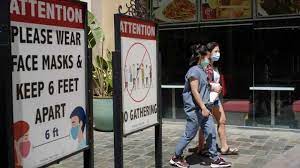 Los Angeles County will reimpose its mask mandate this weekend in the latest sign that public health officials are struggling with an alarming rise in coronavirus cases tied to the highly contagious Delta variant. The latest order not only puts the county further at odds with both the California Department of Public Health and the U.S. Centres for Disease Control and Prevention — both of which continue to maintain that vaccinated people need not cover their faces indoors — but puts officials in the precarious position of asking the inoculated to forfeit one of the benefits recently enjoyed. Vaccinated people are, in essence, being asked to make a sacrifice to help slow coronavirus spread among the unvaccinated.
 It added that a curfew will be imposed from 9pm to 4am, while checkpoints will be set up to prevent people from travelling outside their provinces. Bangkok and nine other provinces have already been under these restrictions, the toughest in more than a year, since last Monday. Thailand is currently battling its longest-running and most severe outbreak so far. The country reported 11,397 infections and 101 deaths on Sunday, bringing the cumulative total to 403,386 cases and 3,341 fatalities.
 Britain’s biggest supermarket groups will encourage staff and customers to keep wearing face coverings from Monday, (today) despite new rules in the country making it a matter of personal choice. The UK government has announced that masks will no longer be a legal requirement in England from 19th July, but government guidance still urges supermarkets to ask customers and staff to wear them in their stores.
 “The goal of the study is to make Covid-19 antibody tests more accessible.” said Johnny Zhang, a PhD candidate at the Institute of Biomedical Engineering and department of chemistry who is one of the co-first authors of the publication. “The end result is that the patients can take a self-diagnosis for Covid-19 with their phone, and that data can be immediately accessed digitally by medical professionals.”
 There were 31,715 travellers under monitoring by the health authorities. Monitoring is being carried out through the ‘MadeiraSafe’ app. There were also 413 people, who had contact with positive cases, being monitored by the health authorities of several Madeira municipalities and of Porto Santo.
 On July 14th, Covid-19 vaccination started on athletes who take part in national and international sports competitions, particularly those from Clube Desportivo Nacional. It started at 15h30 and Pedro Ramos (Madeira’s Health and Civil Protection Secretary) and Jorge Carvalho (Madeira’s Education Secretary) were in Madeira Tecnopólo (a vaccination centre in Funchal) to witness this moment.
 The Madeira Regional Government renewed the pandemic restrictions. As such, the PSP (Polícia de Segurança Pública – Public Security Police) warned it will continue to monitor businesses such as restaurants to ensure compliance with the restrictions. These include compliance with the closing time (midnight), the maximum capacity limit of 2/3 (both indoors and outdoors), the prohibition of food consumption at the counter. The PSP appealed for customers and business owners to comply with the rules. It also reminded that the curfew lasts from 01h00 until 05h00, social distancing is mandatory; all people aged 6 or older must wear a face mask in order to enter and remain indoors or to use public transport; alcohol consumption in public areas and near commercial establishments is forbidden; and no customers can remain inside a restaurant, bar or similar establishment after its closing time. It appealed for people to comply with all rules and recommendations and warned that failure to comply may result in a crime of disobedience and/or in a fine.
 Good morning – We start today by extending our condolences to the families and friends of those who died in the floods in Germany, Belgium and the Netherlands as well as other countries. This is a tragedy beyond all proportions, in terms of deaths, injuries and widespread destruction.
 In crisis situations, debate on Facebook, which is not focused on the facts can create unnecessary, unrelated and long threads. This has a negative impact and makes it more difficult for people to find factual information and answers to questions. In critical situations such delays can even place lives at risk. Where such comments detract from the main topic, be it a health crisis or major fire for instance, we will delete these in the interests of the majority and in order to achieve our mission. The “about us” section on our Facebook page is very clear on this subject.
 At this moment, about 95% of the population over 50 years living on the continent already has a dose of the vaccine administered and 85% has completed vaccination. It should also be noted that, of the adult population residing on the continent, 74% already have a dose of the vaccine and 55% have the complete vaccination schedule.
 On a visit to the vaccination centre in Oeiras, this Friday, Marta Temido admitted the hypothesis that Lisbon is already going through the peak of a fourth wave, acknowledging, however, that more data are needed and praising the vaccination efforts.
 In the letter, released by some media, the 20 signatories portray the current situation in the country, stating that in the last 14 days (until July 8th), the covid-19 mortality rate was 0.03 per 100,000 population, against a mortality rate from other diseases and causes of death of 2.7 per 100,000.
 According to data released this Friday by the National Institute of Statistics (INE), in May there were 2,602 celebrations, which represents an increase of 88.4% from April to May.
 The SYNLAB company has opened ten new units in various regions of the Algarve, to carry out covid-19 PCR and antigen tests, without the need for previous appointments, in the car (“drive” format) or while the customer is on a walk (“walk” format).
 Rui André told Lusa that a meeting with the Secretary of State for Nature, Forests and Spatial Planning, João Catarino, resulted in a commitment to a protocol between the municipality and the tutelage to “ensure support for transport” of the wood still on the ground.
 It is a circular flight from Amsterdam to Terceira, with the final destination, Ponta Delgada, a connection that had been suspended in 2020 due to the covid-19 pandemic.
 “Cases rise when complacency sets in,” she warned during a press briefing. “We are all tired, but after experiencing successive peaks of infections in the same locations, we must break this cycle by embracing public health measures early and consistently.”
 It said that the number of people in isolation is 104. A total of 4,196 confirmed cases of Covid-19 (2,028 females and 2,168 males) have been recorded since March 2020, and 48 people have died from the virus. To date, the authorities have carried out 195,982 tests.
 In total, the Americas has reported nearly 74 million Covid-19 cases and 1.9 million deaths – more than a third of Covid cases and more than 40% of deaths reported globally. If you couple the Big Nations of US and Canada with these Central American and Caribbean countries, we find that in the past week there has been a 50% increase in confirmed new cases compared to the previous week and an 11% increase in deaths.
 In recent weeks, PAHO has delivered personal protective equipment to Haiti, helped expand care for Covid-19 patients, and provided thousands of tests and laboratory materials. PAHO has also helped train community health workers and supported the Ministry of Health in preparing for vaccine introduction and setting up new systems to dispel rumours. Vaccines continue to be inaccessible for many in Latin America and the Caribbean.
 In France the French authorities have announced that the country will introduce stringent rules against unvaccinated persons travelling from the United Kingdom, Spain, and Portugal.
 To be able to enter Germany, in line with the Ordinance on Coronavirus Entry Regulations for vaccinated travellers, everyone is required to be immunised with one of the vaccines approved by the European Medicines Agency (EMA).
 Meanwhile in Cyprus, the country with the highest rate of cases per 100,000 of population in the past week, the country has ceased imposing the requirement of quarantine on arrivals from Sweden and Latvia, whereas travellers coming from Portugal will undergo stricter entry restrictions, as the country is placed in the high-risk category.
 Meanwhile another tourist country, Malta, has been told by the EU that their Travel Ban on unvaccinated people could be discriminatory. The Maltese authorities had previously announced that they would restrict non-vaccinated travellers from the UK due to an increased number of Covid-19 infections.
 And finally, to end this report we look at Estonia, where they have imposed a 10-day mandatory quarantine for all arrivals from Spain and Andorra. This follows the same rules for people arriving form the United Kingdom, Portugal and Cyprus last week. The decision on the three latter countries was set to remain effective until July 11th; however, the increased number of infections pushed Estonia’s government to continue to apply the compulsory self-isolation requirements for travellers from the UK, Portugal and Cyprus until July 18th.
 This was said on the eve of the end of “Operation Periphery”, which, with the support of the ‘task-force’ and a military team provided by the Ministry of National Defence, vaccinated 70% of the population of the islands without a hospital, except do Corvo, which was the first island to achieve group immunity, in March.
 According to the report by the National Institute of Health Doctor Ricardo Jorge (INSA) released today, this variant, associated with India and considered more transmissible, has a prevalence of 86.6% in Portugal, while Alpha, and initially identified in the United Kingdom, only it was responsible for 10.2% of infections in the week of June 28th to July 4th.
 The association based on the University of Algarve’s Campus de Gambelas, informed that this year, the teams concentrated their efforts on Faro beach and managed to cover about 5 km outside the urbanized area, removing plastics and other non-biodegradable materials, such as masks, personal protection and single-use metal packaging.