
Portugal Safety and Security Report Wednesday 13th August 2025
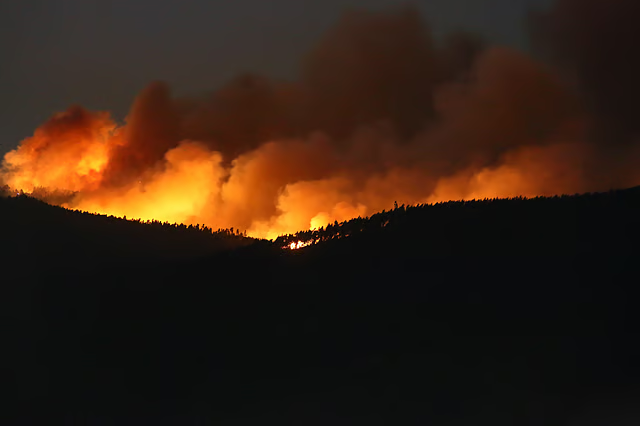
Good morning everyone. The fires over the last 12 days have been extensive, intensive and prolonged. One 12 days from ignition is still actives and there are several that over 3-4 days. This is an illustration of what we have warned of over the last year, that climate change and extreme temperatures is providing the basis for more extreme fires which burn at such an intensity, that it is difficult for firefighters to supress using normal means.
In monitoring these fires daily we cannot recall a time that so many fires have re-ignited from being in resolution or even conclusion some three or four times.
 There is speculation whether or not Portugal will extend the State of Alert for the second time. It is currently due to expire on 13 the August at 23.59 hrs. However, the fire risk for the days ahead are not good with the fire risk forecast being particularly high at 90% of the mainland at very high or above. A decision will need to be reached today.
It was reported on Monday confirmed by the ANEPC that none of Canadair’s firefighting aircraft in the country are operational. The aircraft, which was operating in the Tâmega and Barroso region, had taken off from Castelo Branco when smoke was detected in one of its engines, Civil Protection confirmed to RTP. Shortly after, it returned to the airfield, making an emergency landing. The failure occurred a week after a second Canadair ditched in the Douro. A third Canadair is also not operational.
Avincis, the company responsible for the fleet of Canadair aircraft used to fight wildfires in Portugal, describes an “unprecedented situation.” The aircraft it provided to the Portuguese government are currently inoperable due to mechanical problems.
When these aerial resources are not in operation, particularly in weeks like these, it has a decisive influence – not only in containing the fires, but in many cases in resolving them. Despite being the Mediterranean country with the largest area of burned forest, Portugal is also the only one that does not have its own fleet of these planes – the three in question are rented.
Fortunately Morocco has stepped in activating a bilateral cooperation with Portugal and provided two replacements which arrived on Monday and are now in service. These aircraft normally operate in pairs. Spain was ask to assist but they need their Canadair’s due to the high fire risk situation there. There is no indication that any request was earlier made under the EU Civil Protection Mechanism, which appears strange in these circumstances.
The first Canadair heavy forest firefighting aircraft to replace those that are inoperable arrived in Portugal early this afternoon and a second will arrive “in the coming days,” according to the Avinica company that operates these aircraft. Clearly the speed of replacements reflects the seriousness of the problem and the absolute need for heavy duty firefighting aircraft in these major fires.
Portugal has only completed 40% of its National Action Plan (PNA) to reduce the destruction caused by forest fires: the objective, the newspaper ‘Público’ revealed this Tuesday, was to clear one million hectares of Portuguese forest between 2020 and 2024. However, the clearing operations covered only 400 thousand hectares. According to the National Plan of Action (PNA), which establishes the goals and priorities of the Integrated Rural Fire Management System, the achievement rate for the 98 objectives set by 2030 reached 56% last year. However, experts are more cautious about this assessment. (More about this in our news article below)
Lastly we are experiencing daily temperatures up to 43C/44C in some places .Health in such conditions is vitally import; so please take the advice of DGS concerning steps to avoid dehydration, especially for children and the elderly.
Our team at Safe Communities wishes you a good week ahead.t
News
Only 40% of the national forest cleaning plan has been completed
Portugal has only completed 40% of its National Action Plan (PNA) to reduce the destruction caused by forest fires: the objective, the newspaper ‘Público’ revealed this Tuesday, was to clear one million hectares of Portuguese forest between 2020 and 2024. However, the clearing operations covered only 400 thousand hectares.
According to the National Plan of Action (PNA), which establishes the goals and priorities of the Integrated Rural Fire Management System, the achievement rate for the 98 objectives set by 2030 reached 56% last year. However, experts are more cautious about this assessment.
The performance report, according to Miguel Freitas, former Secretary of State in António Costa’s government, “gives a good picture of the state of the art, but if we look at the physical implementation, which is fundamental, everything remains unfulfilled.” “On the ground, the investment in prevention isn’t felt,” he added. Francisco Castro Rego, academic and former president of the Independent Technical Observatory created by the Assembly of the Republic to define a strategy against wildfires, also indicated that the AGIF report [the agency that coordinates and monitors entities involved in preventing and combating forest fires] “is very well done,” but “it’s just numbers.”
Despite the promises of successive governments, forest clearing, management, and economic development have not changed, as was seen in September 2024: in one week, more than one hundred thousand hectares of forest burned and 16 people died, leading the AGIF to recognize in its report a warning sign for the present and the future: “The fires of September 2024 show that there are difficulties to overcome and call on Portuguese society and its political representatives to mobilize to strengthen the path already defined.”
 Tiago Oliveira, chairman of the agency’s board of directors, emphasized that, after 2023, the sense of urgency that politicians and society in general placed on fighting the fires has been deflated. “It’s essential that the country re-discuss what needs to be done,” he warned, noting that “the difficult things” remain to be done. “Politicians don’t want to discuss the Gordian knots” of the sector in the Assembly. Which ones? Changes to the inheritance system that perpetuates undivided inheritances and abandonment, the financing model for municipalities based on their forest area, or multi-year program contracts with forest producer organizations.
The cleanup of the national forest failed across the board, despite the ambitious goals set by the National Plan of Action (PNA): between 2020 and 2024, one million hectares were to be cleared, and by the end of the program, in 2030, 2.5 million. Resources from agricultural policy, the PRR, and the State Budget were allocated to this end. The clean-up, which was to be coordinated and monitored by ANEPC (National Emergency and Civil Protection Authority), relied on various resources and institutions: sapper goats, contracts with producers and municipalities, programs from the ICNF (Institute for Nature Conservation and Forests), controlled fires, and obligations of electricity and gas grid managers and Infrastructure Portugal.
However, the numbers are revealing: in 2024, grazing with over half a million animals totalled 3,480 hectares; controlled fires totalled 2,100 hectares—94% below the program’s targets. The ICNF, energy companies, and Infraestruturas de Portugal are also reducing their contributions: in 2021, when political and social pressure was high, they cleared 88,000 hectares; in 2024, they cleared 75,000.
The national forest is more vulnerable, exacerbated by climate change: with brush accumulating over the years in the mountains, among the trees, large fires will continue to plague the summer. To stop this threat, Portugal would need to clear more than twice the forest area it is currently managing.
By the end of 2024, almost 338,000 hectares had already burned; this year, with at least two months of hardship ahead, fires have consumed almost 50,000 hectares.