
The Overseas Situation Report Tuesday 8 February 2022
by Mike Evans
“Patience is also a form of action”
– Auguste Rodin
As Portugal eased the requirements for vaccinated travellers to enter Portugal this report is looking at what travel restrictions are in place and where some are being eased as the pandemic gets less severe.
For many the big news of the week is that Australia is to reopen its international border to fully vaccinated travellers from the 21st of February 2022 after almost two years of closure. Prime Minister Scott Morrison said after new medical advice, the new border rules would come into place on February 21.
 “The condition is you must be double vaccinated to come to Australia,” he said. “That’s the rule. Everyone is expected to abide by it.”
The news will be welcomed by tourism bodies, which have been crying out for movement on the border closure that has hampered some businesses. Home Affairs Minister Karen Andrews said unvaccinated travellers would still need to apply for a travel exemption to come to Australia and must undergo hotel quarantine if they were granted permission to enter the country.
Mr Morrison said the government’s definition was that people need to have a full course of a vaccine, which in most cases is two doses but for some international vaccines is only one, to be considered vaccinated. For example, the Johnson and Johnson vaccine — which is approved for use in Australia — involves only one dose.
The expert panel on vaccines, ATAGI, has flagged though that it is considering whether to still use the term “fully vaccinated” or instead move to “up to date with vaccinations” like is used with childhood vaccines. If the definition is changed, it could mean that booster shots are included when considering if someone is “up to date” or not.
Mr Morrison made it clear, with a reference to the recent Novak Djokovic saga, that even if people had the correct visa to enter Australia, if they were not fully vaccinated — or had an exemption — they would not be allowed to enter.
“I think events earlier in the year should have sent a very clear message to everyone around the world that (that) is the requirement to enter into Australia,” he said.
 Meanwhile closer to home in neighbouring Spain, The Spanish Ministry of Health has extended travel restrictions on travellers from the other European Union and Schengen Area countries for another week, until February 13, due to the ongoing spread of the COVID-19 infection in the bloc.
Updating the list of European risk areas, the Ministry has explained that the list will remain unchanged for another week. Part of it are the following EU/Schengen countries: Austria, Belgium, Bulgaria, Czechia, Cyprus, Croatia, Denmark, Estonia, Finland, France, Germany, Greece, Hungary, Ireland, Iceland, Italy, Latvia, Liechtenstein, Lithuania, Luxembourg, Malta, Netherlands, Poland, Portugal, Romania, Slovakia, Slovenia, and Sweden.
“If you come from a country/zone at risk in relation to COVID-19, you must present a certificate or document proving vaccination, diagnostic test for active infection (PDIA), or recovery from COVID-19. These certificates will be different if they have been issued in a country of the European Union (EU Digital COVID Certificate) or in a third country,” the Ministry explains regarding travel from countries in the EU which are listed as risk countries. It also points out that since February 1, travellers who haven’t received a COVID-19 booster dose must pay attention to the validity of their vaccinated certificates. Those who have been vaccinated before mid-May 2021 must take their booster shots and renew their vaccination certificates in order to be eligible to travel to Spain restriction-free.
The Spanish authorities continue to consider as high-risk countries all third countries except for: China (including administrative regions of Hong Kong and Macao) Indonesia, New Zealand, Rwanda, Saudi Arabia, South Korea, and Taiwan.
Regarding travellers from other third countries, which Spain lists as high-risk areas, they have to present their SpTH QR code together with a vaccination or recovery certificate as well as negative COVID-19 results of a test performed pre-departure.
Residents of these countries can travel to Spain with a vaccination certificate against COVID-19, a negative test performed within 72h(NAAT) / 24h(RAT) prior to arrival, or a certificate of recovery from COVID-19. Since last week, only negative results of Coronavirus antigen tests were that performed 24 hours before a traveller’s arrival in Spain will be accepted for entry into the country, instead of 48 hours as they have been accepted up until now. The QR code is obtained when completing the Sanitary Control Form through the Spanish Health portal, pre-departure. Completing the form is obligatory for all sea and air travellers. It is not mandatory to present the document for those reaching Spain by land.
In Germany, the country has followed the recommendation of the European Commission and have decided to shorten the validity of vaccination certificates to 270 days. The new rule on the vaccination passes entered into force on February 1 and affects everyone travelling within the EU. In line with this proposed rule, persons who reach Germany need to provide valid proof that they have received the last vaccine dose (of a two-dose vaccination scheme) within the last 270 days in order to be exempt from additional entry measures, such as testing and quarantine requirement.
It is believed that persons who have been vaccinated more than 270 days ago will be considered unvaccinated when reaching Germany if they haven’t yet received a booster shot.
Nonetheless, the German authorities haven’t yet given any information regarding booster doses and the corresponding interval times. Booster shot refers to the third vaccine that is given to persons who have already completed primary vaccination.
 Apart from this change, Germany has also shortened the validity of recovery certificates. According to the German responsible body for disease prevention and control, Robert Koch Institute (RKI), recovery certificates are now valid for only a period of 90 days. Previously, recovery certificates were valid for 180 days. However, according to the German authorities, unvaccinated persons who have been infected with the virus are only temporarily protected from the disease. For this reason, they have decided to shorten its validity.
“The duration of the recovered status was reduced from 6 months to 90 days because the scientific evidence to date indicates that unvaccinated individuals who have had an infection have reduced and even more temporary protection against reinfection with the omicron variant compared to the delta variant,” RKI notes.
Germany also urged the EU to reduce the recovery certificates’ validity to 90 days. The German Health Minister Karl Lauterbach has called the European Union to make such a proposal in order to protect public health within the bloc.
All of these changes come after the EU Commission is set to extend the Digital Certificate for another 12 months to June 2023. At the end of last week, the Commission brought out a proposal for the Certificate’s extension for another year, after an evaluation that the Coronavirus is still highly prevalent throughout the block, thus determining that it is not possible to cease using the Certificate as a means of safe travel this summer.
According to a press release of the EU Commission announcing the proposal, extending the regulation will enable travellers to continue using their COVID Certificate when travelling to the EU Member States, which maintain entry restrictions.
There are proposals for a number of changes to the certificate. These include, making high-quality laboratory-based antigen tests acceptable for obtaining a certificate in a bid to widen the scope of acceptance tests due to the high demand for them. At the same time, the Commission intends to update the certificates so that they include the correct number of doses of COVID-19 vaccines that a person has been administered, including here the doses administered in the other Member States than the one issuing the Certificate. And finally, the Commission wants to issue certificates to citizens who are part of clinical trials for vaccines against COVID-19 in the hope that such a move will encourage the ongoing development and research of vaccines against the virus.
 Whilst most countries in the EU are happy to continue with the Covid certificate, Finland has said in the last week that they do not feel it is justified under the current situation. Finland’s Minister of Justice Anna-Maja Henriksson has stressed that the certificate was projected as a mechanism to stop the further spread of the Coronavirus during the previous phases of the epidemic, taking into account the fact that the vaccinated persons were more unlikely to contract the virus.
According to Henriksson, with the spread of the Omicron variant, “it appears” that vaccines against the virus do not prevent infections but rather more severe forms of the disease. The Minister emphasised that all restrictions to the rights of people must be proportionate and necessary. “The coronavirus passport limits the basic rights of those people who haven’t got vaccinated, obtained a negative test result, or had the disease. The Coronavirus or vaccination passport isn’t well suited for use in these circumstances because its necessity and proportionality are difficult to justify right now,” the Minister pointed out in this regard.
For those travelling, Stay Safe until the next time.
Total Cases Worldwide – 396,596,256
Total Deaths Worldwide – 5,760,642
Total Recovered Worldwide – 315,336,753
Total Active Cases Worldwide – 75,498,861 (19% of the total cases)
Total Closed Cases Worldwide – 321,097,395
Information and Resources:
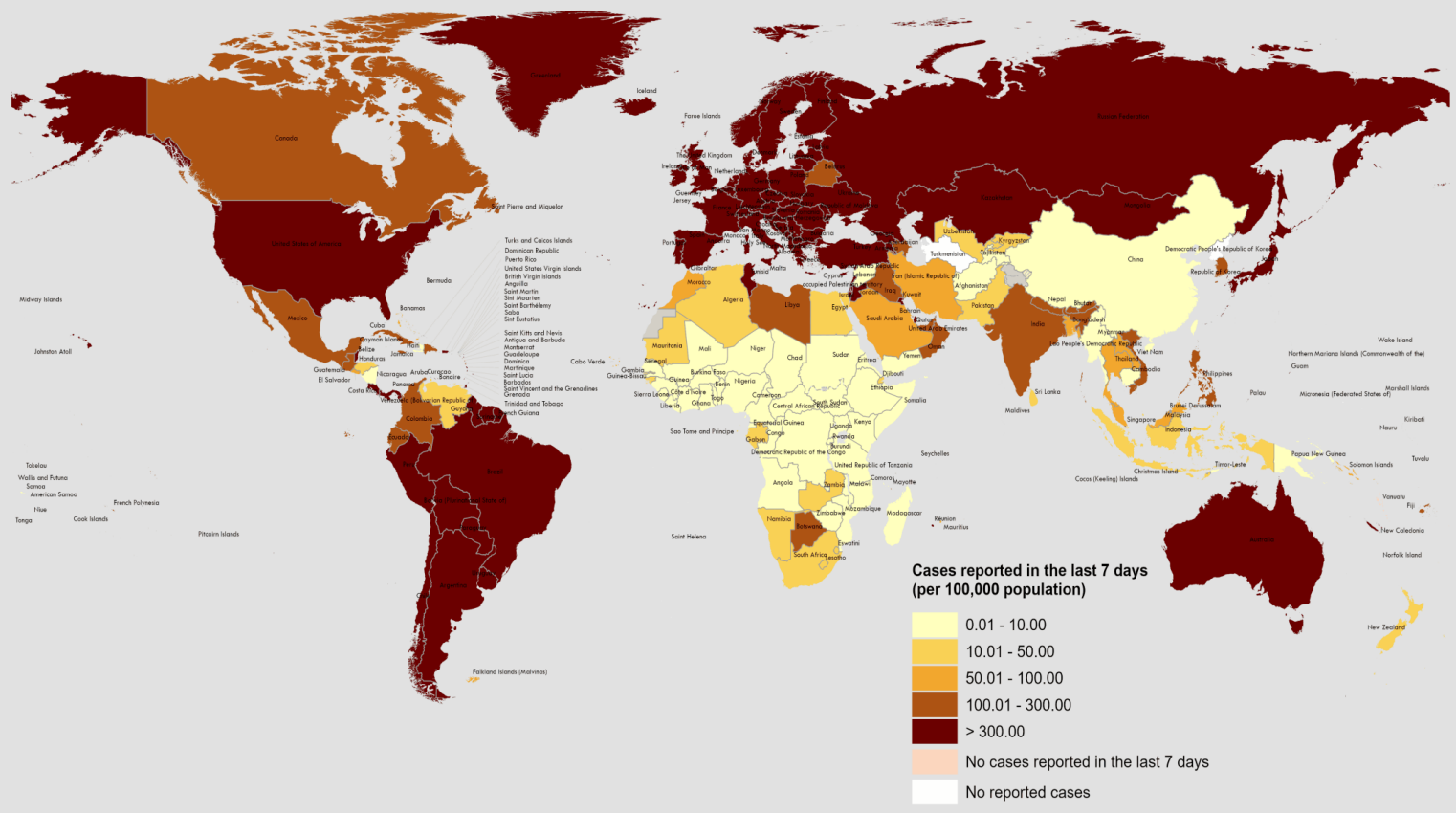 At the Regional level, increases in the number of new cases were reported by the Western Pacific (37%) the Eastern Mediterranean (24%) and the European (7%) Regions, while decreases were reported by the Region of the Americas (20%) and the South-East Asia Region (8%). The number of new cases reported in the African Region remained similar to that of the previous week.
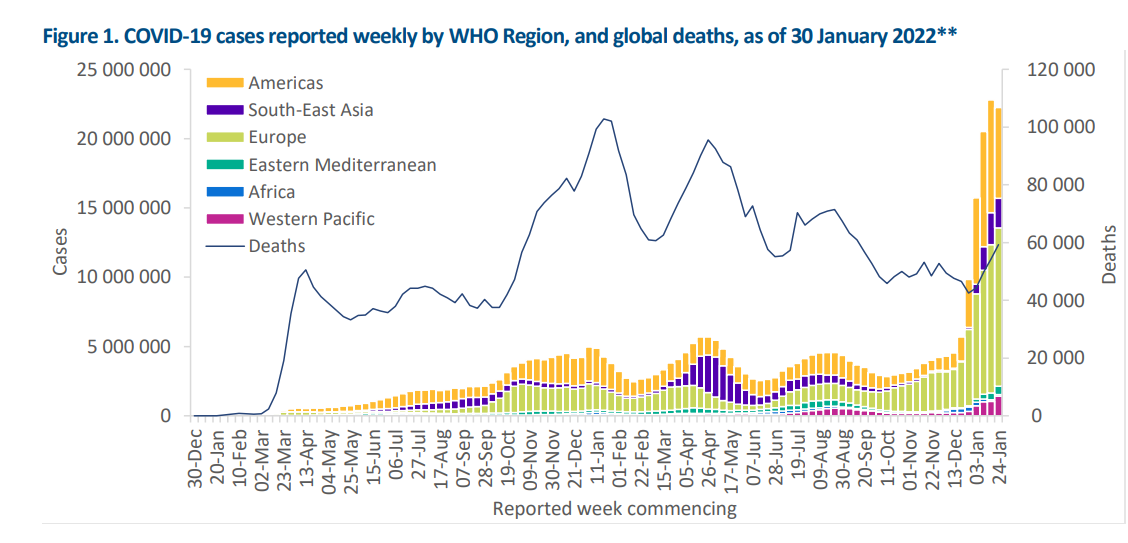 The number of new weekly deaths continued to decline in the Region with over 1600 new deaths reported, a 7% decrease as compared to the previous week. The highest numbers of new deaths were reported from South Africa (842 new deaths.
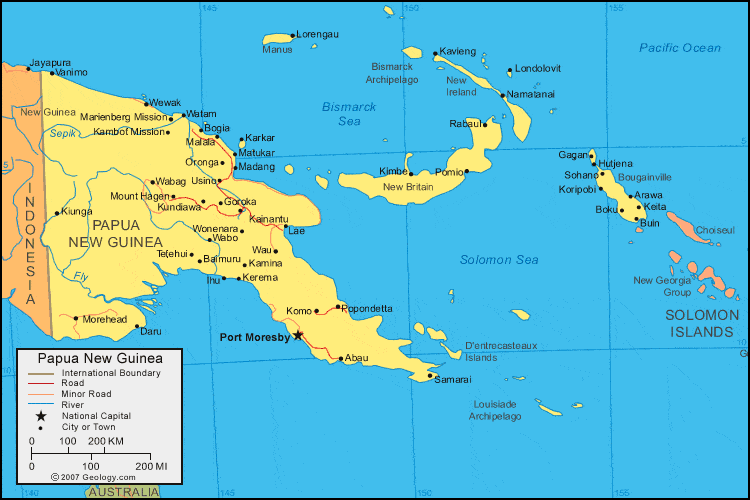 The number of new cases in Western Pacific Region increased by 37% as compared to the previous week, with over 1.4 million new cases reported. Half of the countries in the Region reported increases of over 20% in new cases, with the highest proportional increases reported from Papua New Guinea (339 vs 81 new cases; a 319% increase), Kiribati (142 vs 39 new cases; a 264% increase) and Palau (1021 vs 319, a 220% increase).
 However, one particular spectacle which is about to start is having to deal with the effects of Covid. The winter Olympics are due to start in Beijing very shortly and whilst the world has been dealing with their issues of Covid, The Chinese Government has been trying to keep a lid on it through some would feel draconian measures for its citizens.
 As touchdown began in earnest this week, athletes were getting tested en masse at Beijing International. (It’s the PCR throat swab this time.) To avoid needless interaction, they’re carrying their own suitcases. They’ve been shown to their seats on socially distanced buses run by the Chinese organising committee. (Bus and taxi drivers are trapped inside the bubble, too.) And then they’re off through the “processing centre” to wait up to six hours for test results inside the closed loop — a pandemic purgatory of isolation, action sports, and a nebulous nether region reserved for quarantine.
 Europe has recorded 9,629,074 new COVID-19 cases in the last seven days, the majority of which are Omicron cases, data by the World Health Organisation (WHO) show. European Union Member States top the table as the European countries with the highest number of cases. Yet, despite the numbers, some EU and Schengen Area countries are already facilitating restrictions by removing some measures which were imposed at the end of November 2021, when the existence of the Omicron virus variant was first detected in southern Africa.
 Therefore, since the quarantine rule currently has little to no significance when it comes to halting the spread of the virus, starting from tomorrow, January 26, all unvaccinated and unrecovered travellers will be permitted entry to Norway without having to follow the quarantine requirement. Nonetheless, it has been emphasised that travellers who haven’t been vaccinated or recovered from the virus are still required to take a pre-entry test.
 The Danish government has announced the end of domestic restrictions imposed due to Coronavirus, as the country no longer categorises the virus as a socially critical disease. The new rules will enter force on February 1, and, according to them, several restrictions such as wearing a face mask, presenting the vaccination certificate to enter leisure facilities, and following a curfew restriction will no longer apply.
 On the other hand, unvaccinated travellers, as well as those who haven’t received an additional dose, will continue to be subject to the ten-day quarantine requirement unless they are part of the exemption list.