
Marking 80 years since U.S. dropped atomic bomb on Hiroshima
The city of Hiroshima, in southwestern Japan, has marked the 80th anniversary of the US atomic bombing of the city. Many elderly survivors attended the memorial service for the victims of the first military use of nuclear weapons, expressing their frustration at world leaders’ growing support for these weapons as a deterrent.
With the number of survivors rapidly declining and their average age exceeding 86, this is considered the last major memorial event for many of them.
“In 10 or 20 years, there will be no one left to share this sad and painful experience,” said Minoru Suzuto, a 94-year-old survivor, after kneeling to pray at the cenotaph. “That’s why I want to share my story as much as I can.”
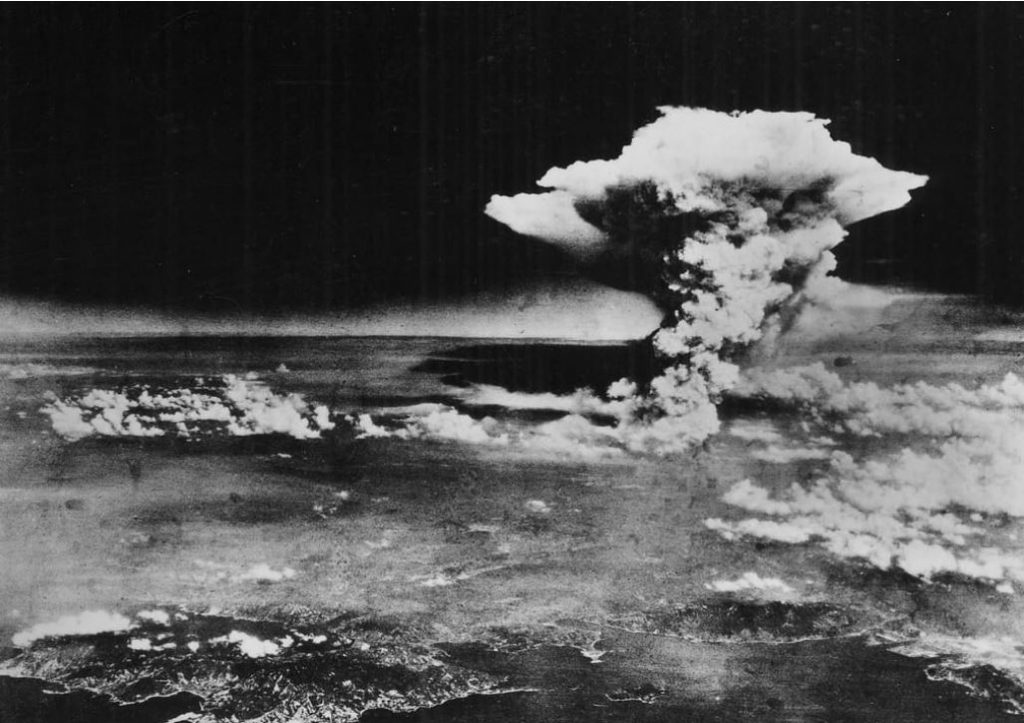
The dropping of the atomic bomb
On August 6, 1945, the bomber “Enola Gay” dropped the first atomic bomb on Hiroshima. The detonation that caused the instant death of around 80,000 people and sparked a legacy of nuclear weapons research that endures to this day.
August 6, 1945. Victory in Europe had been agreed upon three months earlier, but the United States and Japan were prolonging World War II. President Truman wanted to end the war, but Japan refused to surrender. Until, on a Monday morning, the bomber “Enola Gay,” commanded by Colonel Paul W. Tibbets, took off from the Mariana Islands, heading for Hiroshima.
On board was “Little Boy,” the world’s first atomic bomb to be dropped in a wartime context.
About 80,000 people died instantly, while tens of thousands would die months and years later from the effects of radiation.
More than a square kilometre of Hiroshima city was obliterated, crushed by the impact of the “Little Boy” bomb, which detonated 580 meters above ground. Nearly everyone within the fireball’s radius of approximately 198 meters died instantly. Further out, within a 2-kilometer radius, everyone suffered third-degree burns, and within a 4-kilometer perimeter, 45% of people would eventually die from the effects of radiation.
In the end, around 100,000 people died and more than half of the city’s buildings, many up to 9 kilometres away from the point of impact, were left in ruins.
At that time, Hiroshima was an important centre of Japanese military life and had about 300,000 inhabitants.
Photo; Hiroshima, Japan, in 1954, nine years after the atomic bomb was dropped. Photo: IMAGO/piemags via Reuters Connect
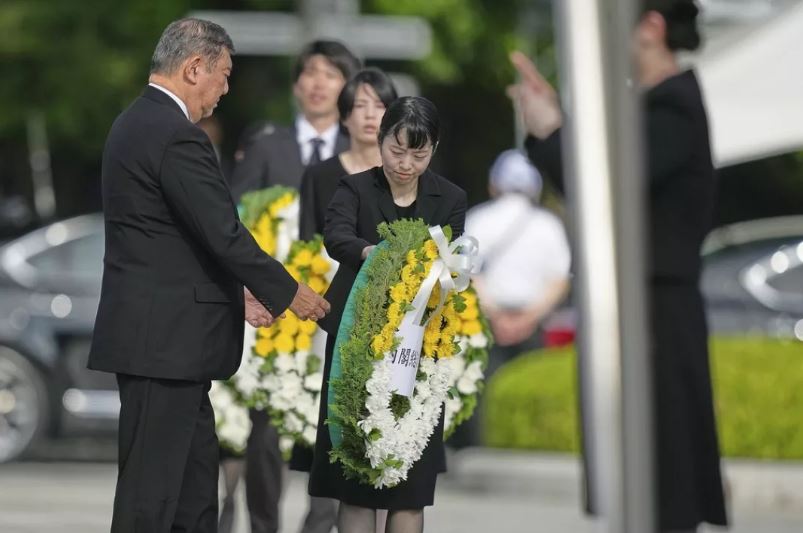
Japanese Prime Minister Shigeru Ishiba lays flowers at the Memorial Cenotaph during a ceremony marking the 80th anniversary of the bombing of Hiroshima, Japan, Wednesday.
Read more
The ” Little Boy” bomb was the result of years of research, but was only tested once. The concept was simple: gathering uranium or plutonium at sufficiently high speeds would create a “critical mass” so quickly that it would trigger an uncontrolled, near-instantaneous chain reaction of neutrons destroying atomic nuclei.
The lost mass of each atom is converted into energy at an astonishing rate. Only 1.09 kg of the 64 kg of uranium in “Little Boy” was converted into energy. This was the equivalent of detonating 15,000 tons of TNT, according to calculations by the Los Alamos National Laboratory in the United States.
Since World War II, no country has attacked another with a nuclear weapon. But at least eight have developed such weapons, and as scientists theorized new designs—including the much more powerful fusion weapons, so-called “hydrogen bombs”—tests began around the world. More than 2,000 nuclear detonation experiments have taken place since Oppenheimer saw the fireball from the Trinity test in the New Mexico desert.
For decades, many of these tests were atmospheric, meaning the weapons were detonated above ground and sometimes even in space. Others were underground, detonated in vaults deep below the surface, intended to contain the blast and prevent radioactive fallout, while instruments measured the performance of the new designs.
These tests have human consequences. Even when things went according to plan, early atmospheric tests released radioactive fallout into the atmosphere, which could travel hundreds of kilometers.
But when the plan went wrong, the results could be catastrophic. The “Castle Bravo” test, conducted by the United States in 1954, was intended to evaluate the design of a 5-megaton weapon—the equivalent of 5 million tons of conventional explosives.
Instead, the device exploded with a yield of 15 megatons, vaporizing many of the test instruments and releasing radioactive fallout into the atmosphere. Several hours later, it engulfed a Japanese fishing vessel called the Daigo Fukuryū Maru. All 23 crew members became ill from radiation, and one died.
Hundreds of indigenous people were removed from their homes in and around the South Pacific atolls, where the United States conducted most of its atmospheric testing.
The US atomic bomb attacks on Japan remain the only military use of nuclear weapons.
Currently, there are nine countries that possess nuclear weapons: the US, Russia, France, China, the UK, Pakistan, India, Israel, and North Korea. The US and Russia together possess about 90% of the world’s nuclear warheads.